Mating behaviour

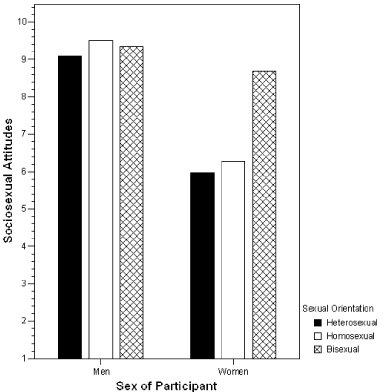
‘Sociosexuality’ measures mating style preference, expressed on a continuum from extreme monogamy (low index) to extreme polygamy (high index).  A 25-language 48-nation >14.000-participant study (Schmitt, David (2005), ‘Sociosexuality from Argentina to Zimbabwe: A 48-nation study of sex, culture, and strategies of human mating’, Behavioral and Brain Sciences, 28, p. 247-311) found that men are consistently more enthusiastic about polygamy than women:

sociosexuality_gender

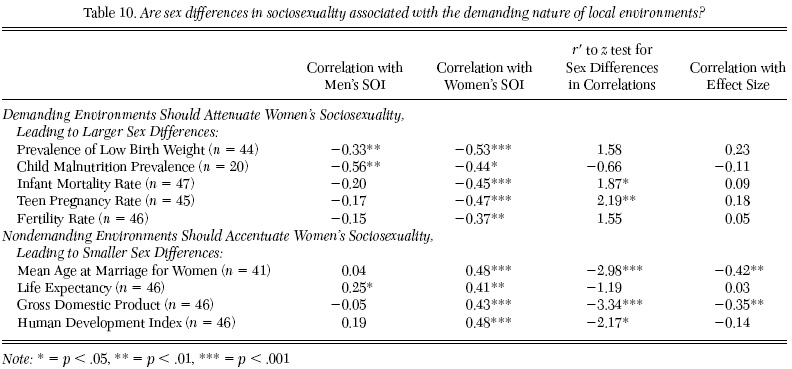
That much is expected. In addition, the study found that elevated male/female ratios and environmental stressors correlate with lower sociosexuality:

sexuality_environment

CO2 buffering capacity of our oceans

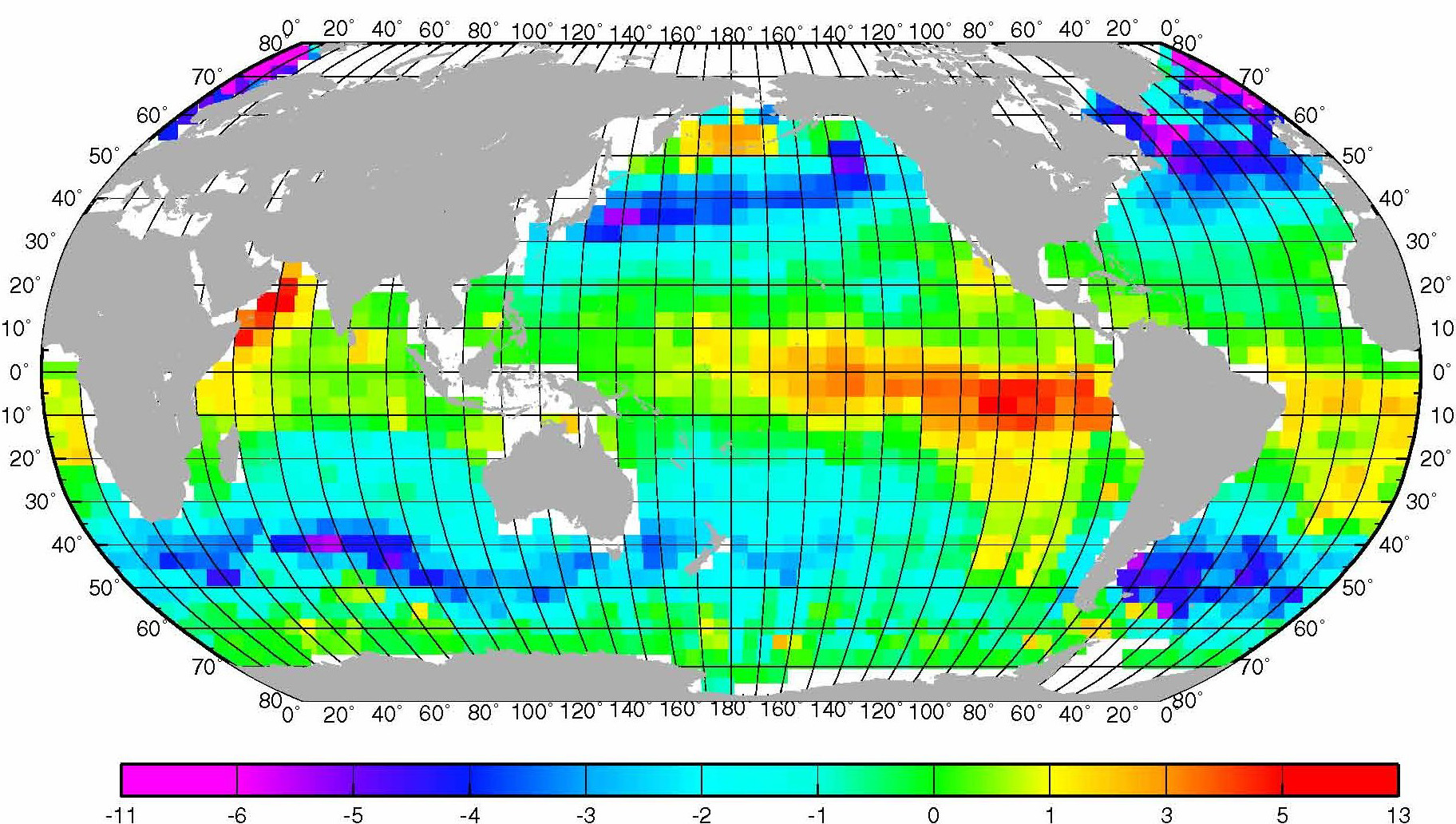
The equivalent of ~25% of current anthropegenic CO2 additions to the atmospheric reservoir is buffered by the oceans:

ocean_co2_flux
Net moles CO2 m-2 yr-1

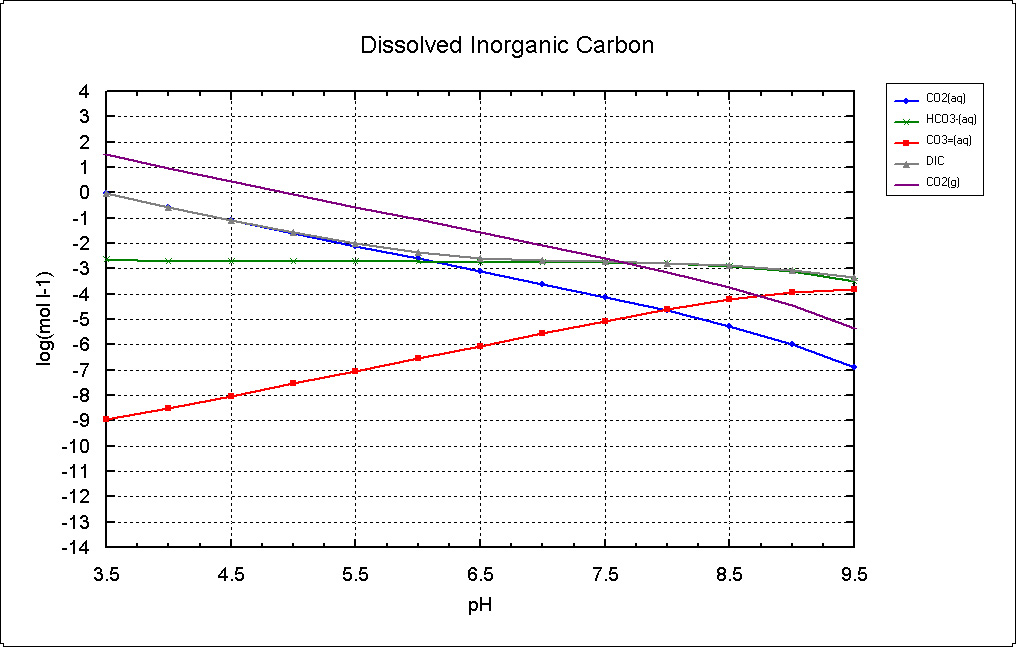
Dissolved CO2 exists as different species: CO2(aq), HCO3-(aq) and CO3=(aq). Ocean pH is the dominant control on this speciation, itself a function of pCO2:

dic2
Dissolved Inorganic Carbon ('DIC') speciation (in log(mol per litre) units) as a function of ocean pH. Partial pressure of CO2 (in log(pCO2, atm) units) also shown. {www.realfuture.org}

CO2 speciation greatly affects CO2 fluxing across the ocean-atmosphere boundary, as only non-ionized species (that is, CO2(aq)) are free to exchange with the atmosphere. Anthropogenic increases in ocean acidity can be expected to greatly lower the CO2 buffering capacity of our oceans.

Four Whys

Predictably, I oft run into trouble when called upon to explain my behaviour. Questions along the lines of “Why did/do you …” induce stall. Niko Tinbergen’s (‘On aims and methods of ethology’, 1963) scheme helps me out.

As a littler chap, I was once stalked by a lioness. Seeing those cold yellow eyes bear into me, “why did I freeze?”

(1) The proximate why. Mechanistic.

“I froze because {lioness-poised-to-charge-me sense-data} came to be processed by my brain, which consequently co-ordinated a state approximating physical paralysis. “

(2) The ontogenetic why. Conditioning.

“I froze because repeated childhood experience with being hunted by my sisters in the garden had instilled a more-or-less automated freeze-when-hunted-and-spotted reaction within me.”

(3) The phylogenetic why. Evolutionary history.

“65.9 million years ago, an ancestral proto-mammal who had circumstantially come to be endowed with a mutant primitive freeze mechanism survived a dinosaur tirade that wiped out all his non-freezing relatives. Through continued natural selection my phylogenetic traits incorporate a polished edition of this freeze response.”

(4) The functional why. How does the queried behaviour increase fitness?

“Freezing presented a desperate stab at survival, maximizing {my genes/my/my species/…} chances at procreation.”
Paleocene/Eocene Thermal Maximum

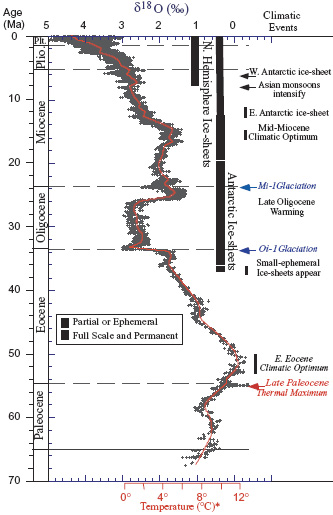
~55 million years ago, the Paleocene/Eocene Thermal Maximum saw global temperature increase by ~5°C in ~15000 years:

zachos_2001
Zachos (2001), 'Trends, Rhythms, and Aberrations in Global Climate', Science 292, p. 686.

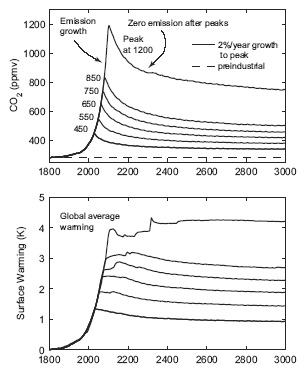
Today, we face a similar ~5°C temperature increase, but wrought within ~one tenth the amount of time:

solomon_2009
Solomon et al. (2009), 'Irreversible climate change due to carbon dioxide emissions', PNAS 106, p. 1704-1709.

How will the {Earth System}’s negative feedback cycles respond in the face of this unprecedented rate of change?