Bodley distinguishes two broad streams, or perspectives, in sociology – and claims that the model he presents in Power of Scale bridges them. One is the “interpretive, symbolic or postmodern†approach. This view, using Bodley’s example of feudal Southeast Asia, “emphasiz[es] cultural meanings and symbolic views … describ[ing] political rulers as benevolent figureheads who were primarily concerned with building temples, hosting ritual spectacles, and protecting the populaceâ€. Under this account, I suppose, Bodley subsumes the views of those who hold that inequitable distribution of wealth is something of a necessary evil towards greater goals like the Hubble Space Telescope, Le Louvre, and the Great Pyramid of Giza.
The other is the “materialist, political-economic or practice†approach, which tends instead to express itself in terms of ‘exploitation’ and ‘power’. By my reading, Bodley’s work is more of an elaboration of the latter than its bridge to the former. Marx’ bicameral proletariat/bourgeoisie society is stretched out like a pyramidal accordion into a multi-tiered hierarchy with very gentle slopes. Ownership of factors of production is de-emphasized in favour of control over lower-tiered human beings, through the manifestation of ‘social power’.
Different types of society allow different scales of pyramid, and Bodley recognizes three scales – perhaps borrowed loosely from Eric Wolf’s division on the basis of ‘kin-ordered’, ‘tributary’ and ‘capitalist’ –modes of production. Bodley calls them the “domesticâ€, “political†and “commercial†–scales.
The picture that emerges is one of society as a pyramid whose slope is invariant, but whose height is determined by the size of the society it represents. The larger a society, the more tiers it can support, and the larger becomes the aggregate control (= power over underlings) by elites occupying the apex. However, Bodley acknowledges that the individual wealth of those occupying the base of the pyramid also increases with scale, so we get something like this:
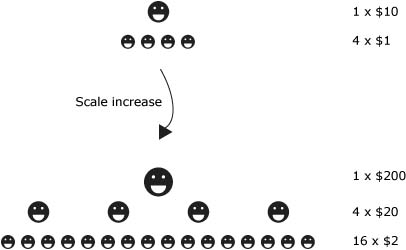
In my picture of a society that is scaling up, I use income as a proxy for Bodley’s ‘social power’ – as he himself often does. The lowest-tier per-capita income increases from $1 to $2, while the increase between adjoining tiers remains constant (at factor 10). Average income increases from $2.80 to $14.86. However, and this is Bodley’s point, the majority see their relative income dropping: a drop relative to both total income and average income. The converse increase in the relative income of those in the upper tiers is tantamount to Bodley’s core contention: power becomes increasingly concentrated with scale.
The so-called ‘progressivist’ argument is aptly epitomized by Bodley as the idea that “over the long run people have in sum been getting richer, and more moral, as the scale of culture has increased.†Curiously, Bodley’s model and all his supporting data can actually be taken to support that view, if one chooses to use absolute wealth as the unit of analysis. To balance that argument, many recent findings from the science of happiness can be brought to bear: more than any factor, ceteris paribus, it is the disparity in socio-economic status between members of a society that correlates with overall well-being.