(2008) Andrew Bacevich
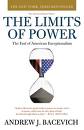 Content. Draws heavily on the thought of Karl Paul Reinhold Niebuhr. America faces impediments on (i) cultural (profligacy leads to deficits and resource dependence); (ii) political; and (iii) military fronts. Much-needed focus is brought to bear on the notion that military commitment can bring about economic growth, à la Nitze’s (1950) NSC-68. The major novel hypothesis is that the quality of senior U.S. military leadership has sharply declined since WWII, and that this is responsible for failures in Iraq and Afghanistan.
Jelte, I haven’t read this book, but am just reacting to the last sentence, which suggests that the same quality as the one that proved itself in WWII is nowadays lacking. Yet isn’t the point a different one: that entirely different military qualities are needed? and that it is ‘the military an sich’ that has to adapt? (I am aware I am saying the obvious here.)
Bacevich might agree that the challenges facing the U.S. military are very different today than a half-century ago. His argument is, however, that the quality of leadership has deteriorated.