Richard Tol (2014)
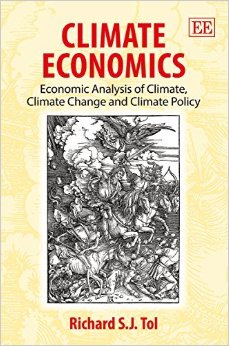 One of the first attempts at a textbook on Climate Economics. Probably the best overview of neoclassical climate economics in a single volume. For a critical non-neoclassical review, read Chalmers & Shackley’s (2014) review of the book.
One point: as a neo-classicist, Tol has a deeply instilled ‘equilbrium view’ and brings this epistemic perspective to his view of how the ‘natural world’ works. His is a view of climate change as a continuous secular process that amounts (‘merely’) to a x-degreeC-per-year change in temperature. What ‘equilibrium thinkers’ need to understand is that the Earth system is currently not in equilibrium; most of the mounting costs aren’t to do with the (more predictable) secular changes in average temperatures and precipitation: they are to do, rather, with the increased variability and (associated) decreased predictability of ‘weather’. Note that I am not speaking here about the uncertainty to do with future (average) temperature trends.
I think this is important, because people trained in economics (and more especially finance) should at least have an strong intuition for the costs (‘premium’) associated with decreased predictability / increased variability – although to date little work has been done in tying this into climate change economics.