Category: Philosophocastry
§1 De Deo / Of God
BS: D1. Per causam sui intelligo id cujus essentia involvit existentiam sive id cujus natura non potest concipi nisi existens.
SS: D1. By that which is self-caused I mean that whose essence involves existence; or that whose nature can be conceived only as existing.
:: What does BS understand by conceivability?
§6 Der Geist / The Spirit
GWH: Die Vernunft ist Geist, indem die Gewißheit, alle Realität zu sein, zur Wahrheit erhoben und sie sich ihrer selbst als ihrer Welt und der Welt als ihrer selbst bewußt ist.
HTG: Reason is spirit, since the certainty of being all reality has been raised to truth, and it is self-consciously aware of itself as its own world, and the world as itself.
:: Can something be [self-consciously aware] of something else? Is it not (i) self-conscious, or (ii) conscious of itself, rather than self-conscious of itself? Continue reading §6 Der Geist / The Spirit
Lavoisier’s Elementalism
“[…] the fondness for reducing all the bodies in nature to three or four elements, proceeds from a prejudice which has descended to us from the Greek Philosophers. The notion of four elements, which, by the variety of their proportions, compose all the known substances in nature, is a mere hypothesis, assumed long before the first principles of experimental philosophy or chemistry had any existence. In those days, without possessing facts, they framed systems; while we, who have collected facts, seem determined to reject them, when they do not agree with our prejudices. The authority of these fathers of human philosophy still carry great weight, and there is reason to fear that it will even bear hard upon generations yet to come.”
– Antoine Lavoisier (1789), Elements of Chemistry
(Stolen from: ‘synapsomatic’)
Totemism
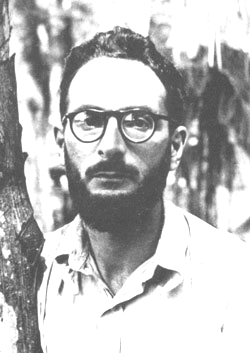 “To accept as a theme for discussion a category that one believes to be false always entails the risk, simply by the attention that is paid to it, of entertaining some illusion about its reality. In order to come to grips with an imprecise obstacle one emphasizes contours where all one really wants is to demonstrate their insubstantiality, for in attacking an ill-founded theory the critic begins by paying it a kind of respect.”
РClaude L̩vi-Strauss (1962), Totemism; translation Rodney Needham
On what there is
By Willard van Orman Quine
[Published in Review of Metaphysics (1948). Reprinted in From a Logical Point of View (1953).]
A curious thing about the ontological problem is its simplicity. It can be put in three Anglo-Saxon monosyllables: ‘What is there?’ It can be answered, moreover, in a word—‘Everything’—and everyone will accept this answer as true. However, this is merely to say that there is what there is. There remains room for disagreement over cases; and so the issue has stayed alive down the centuries.
Inference patterns
(Trans) Transitivity
p □→ q, q □→ r, therefore p □→ r
(Contr) Contraposability
p □→ q, therefore ~q □→ ~p
(Stren) Strengthening
p □→ q, therefore (p & r) □→ q
Equivalence
|
System |
Reflexivity |
Symmetry |
Transitivity |
|
T |
√ |
|
|
|
B |
√ |
√ |
|
|
S4 |
√ |
|
√ |
|
S5 |
(√) |
√ |
√ |
Logic Systems
System T
(1) □ p → p
(2) □ (p → q) → (□ p → □ q)
System B (Brouwerian)
(3) p → □ ◊ p
System S4 (Lewis)
(4) □ p → □ □ p
System S5 (Lewis)
(5) ◊ p → □ ◊ p
Rabbi Akiva on Good & Evil
 Good ol’ Rabbi Akiva ben Joseph (~50-135 CE) had it figured out. God punishes the good in this short life, for their few sins, and rewards them eternally in the world to come. Similarly, God rewards the evil-doers in this short life for their few good deeds, and punishes them eternally in the world to come. Quod erat demonstrandum.