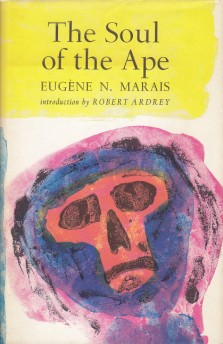
The Soul of the Ape

(Written 1920s, published 1969) Eugène Marais

The Soul of the Ape shows what a tremendous difference a polished edit can do for the conveyance of ideas.  The work was put together by Robert Ardrey, Marais’ tireless exponent, from an unfinished manuscript found many years after the author’s suicide.  This makes it hard to hold many of Marais’ ideas up to the light.

Why what Marais has to say about baboons might interest us

Marais’ isolated existence in a narrow kloof in South Africa’s Waterberg Plateau in the 1920s had two important consequences.  The first was that, despite his rigorous scientific training, he remained untouched by the influence of scientific work being done elsewhere.  The second was that his subjects, a large troop of Chacma baboons, were largely untainted by human contact – outside of their doings with Marais himself.  Because of the location of Marais’ hut, the baboons had no choice but to pass the astute observer every morning on their way out in search for food, and every evening on their way back to the home cave.  Marais was a gifted naturalist who was able to carry out a detailed study of primates under highly favourable conditions before ‘primate science’ existed. Continue reading The Soul of the Ape

Postmodernism

(2002) Christopher Butler

Postmodernism has a lot to offer.

“Q   Haven’t you simply called this glass of water an oak tree?                                                              A   Absolutely not. It is not a glass of water anymore. I have changed its actual substance. It would no longer be accurate to call it a glass of water. One could call it anything one wished but that would not alter the fact that it is an oak tree …”


The Power of Scale

(2003) John Bodley


Bodley distinguishes two broad streams, or perspectives, in sociology – and claims that the model he presents in Power of Scale bridges them. One is the “interpretive, symbolic or postmodern” approach. This view, using Bodley’s example of feudal Southeast Asia, “emphasiz[es] cultural meanings and symbolic views … describ[ing] political rulers as benevolent figureheads who were primarily concerned with building temples, hosting ritual spectacles, and protecting the populace”. Under this account, I suppose, Bodley subsumes the views of those who hold that inequitable distribution of wealth is something of a necessary evil towards greater goals like the Hubble Space Telescope, Le Louvre, and the Great Pyramid of Giza. Continue reading The Power of Scale

Biofuels and the Globalization of Risk

(2010) James Smith

In writing this book, Smith sets his sights on more than just the consequences and risks, global and local, wrought by the (imprudent, he argues) adoption of biofuel technology and -policy.  His is also a deeper and more general meditation on the present Era’s faith in technology: “This narrow perspective, of looking to first-, second- and third-generation technologies to deal with the world that confronts us, blinds us to the teleologies that led us there in the first place.”  Biofuels present an ideal lens through which to cast light on this simple and profound observation. Continue reading Biofuels and the Globalization of Risk

The Collapse of Complex Societes

(1989) Joseph A. Tainter

Tainter presents a detailed review of the major theories on societal collapse.  Through appeal to diminishing marginal returns on complexity, Tainter takes a pseudo-economic line to argue that decay is inevitably in the cards for any complex society.  Unfortunately, little attempt is made to constrain the notion of ‘complexity’.  In reference to the prospect(s) for modern society, one of Tainter’s more interesting observations is that complex societies that exist as islands in a sea of barbarism tend to collapse suddenly and dramatically, while those that exist amongst estimable competitors tend to undergo long, drawn-out decay as power is slowly but surely usurped.  Rather than the desperate bank-runs and grocery-store pillages envisaged by some, I would not be surprised if Tainter envisages a less catastrophic 21st Century in which the United States and Europe slowly deteriorate into a backwater of China.

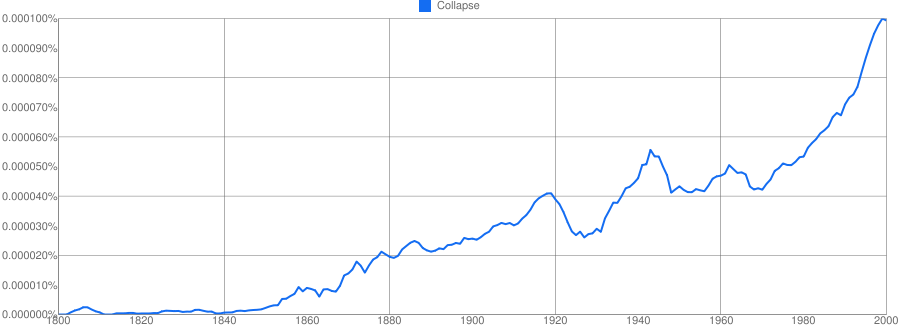
Talk of collapse is becoming increasingly fashionable, as is starkly illustrated by analysis of the word ‘collapse’ in English literature: (using the on-line database at http://www.culturomics.org/)

Relative occurrence of the word 'collapse' in a large sample of English books

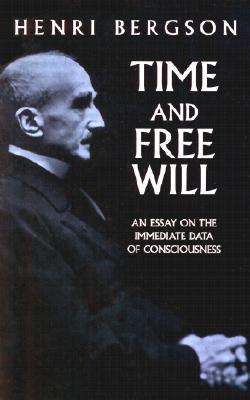
Essai sur les données immédiates de la conscience / Time and free will

(1889) Henri Bergson

Bergson subscribes to a kind of dualism.  Like Descartes’, his cleaves subject and object.  However, in contrast to the Cartesian doctrine, for Bergson this cleft is much more a consequence of rather than a grounding for his philosophy.

The deeper distinction for Bergson lies between what he calls the quantative and the qualitative [1]. One important difference that sets these apart lies in the nature of the multiplicity which is inhered.  Quantitative multiplicity consists in juxtaposition, making it possible to speak of discrete ‘objects’.  Qualitative multiplicity, on the other hand, consists in interpenetration.  Unlike the former, the latter is not amenable to division, with major consequences for epistemology. Continue reading Essai sur les données immédiates de la conscience / Time and free will