
Category: Erudition
Influential reading
Sundry Non-Random Maps: 1

On Reading Hegel
In the beginning, one is never quite sure whether one is being conned.
I have thrown Hegel across rooms more often than any other author.
No other author have I had to hide from myself as often.
Stream-of-consciousness philosophy. Almost impenetrable in an analytical age. Just when you think you have found something to grasp on to …
A painful, mind-bending slippery slope that folds in on itself.
But then, with time …
… the light. Perhaps.

How many people truly understand Hegel?
Lecture Course in Hegel’s Science of Logic by Richard Dien Winfield: http://archive.org/details/LectureCourseInHegelsScienceOfLogic-RichardDienWinfield
Thinking, fast and slow
Daniel Kahneman (2011)
 This book didn’t just profoundly affect the way I think about the behaviour of human individuals, it actually affected the way I structure my thinking about the behaviour of human individuals. It’s honestly hard to imagine a walk of life in which Kahneman’s book would not be an invaluable read.
Peeking at Peak Oil
Kjell Aleklett (2012)
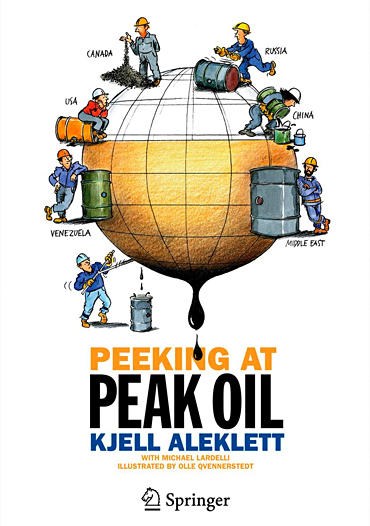 Despite trying hard not to, I really really like this book. Wonderfully illustrated, and written in a clear and unpretentious style, I have no choice but to go on record saying: great book, Kjell. If you read only one book on Peak Oil, this is the one. Read about some of Kjell’s forecasts here.
The Construction of Social Reality
John Searle (1995)
 Given the subject matter, John Searle’s The Construction of Social Reality is an accessible book, and well worth reading.
I have some problems with a few of the arguments:
(1) Pre-supposing a realist ontology
Searle explains ‘representation’ as follows (p. 150/151; italics mine): “Human beings have a variety of interconnected ways of having access to and representing features of the world to themselves. These include perception, thought, language, beliefs, and desires as well as pictures, maps diagrams, etc. Just to have a general term I will call these collectively representations.” He then dedicates two entire chapters to the defense of ‘external realism’ in the face of ‘anti-realist’ attacks. He defines ‘external realism’ (p. 150) as the view that “the world (or alternatively reality or the universe [sic]) exists independently of our representations of it.”
So: (i) a notion of representation that relies on the existence of ‘the world’ is set up and implemented. (ii) notions of ‘realism’ and ‘anti-realism’ are set up and implemented that rely on the world existing independently and dependently of representation, respectively. (iii) the case is then made that much of our normal understanding and discourse already presupposes realism, and are unintelligible in it’s absence. (iv) the onus is then shifted onto the shoulders of anti-realists, who are now called on to replace ‘normal background understanding’ with an alternative that would make anti-realism intelligible.
My issue is this: if you’re going to hang the notions of realism and anti-realism on the independence or dependence of representation on ‘the world’, then obviously you’re already buying into a realist ontology – not because of reliance on ‘normal understanding’, but because the very criteria by which you propose to swing the argument already appeal to such a thing as ‘representation’, which in turn appeals to such a thing as ‘the world’.
(2) Ontological objectivity
“[t]he presence of snow or ice near the summit of Mt. Everest is in no way dependent on the existence of human or other sorts of representations.”
“in no way dependent”!? Searle’s own example sits uncomfortably with me. “Snow or ice”, you say? So is this white stuff that I’m pointing to, right here on the summit of Mt. Everest, snow or ice? What’s that you say? “It depends on where we agree to put the referential boundary between snow and ice.” If the disambiguation between snow and ice, between mountains and ridges, etc. requires social agreement – which it does – then something feels wrong to me about the claim above.
Meanwhile, we’re supposed to accept that a $5 bill buried in the ice on top of Mt. Everest is no longer a $5 bill in the absence of representation.
Whether or not there is a mountain, whether or not it has snow or ice near its summit, and whether or not the piece of green paper buried in there is or is not a $5 bill are all questions whose answer – like the answer to any question – relies on social agreement. Maybe I want to say that there is something there in the absence of representation, but that it is impossible to say what it is without representation.
What’s happened here, I think, is that Searle (consciously or unconsciously, I’m not sure which) buys into functionalism: to him, for a certain class of entity, function plays an important role in rendering its identity, in determining what it is, and in some contexts apparently even determines whether or not it is even existent. An ontological distinction is made, with ontologically objective and subjective entities respectively characterised by the absence or presence of function. This is why a $5 bill ceases to be a $5 bill, in his system, if all representation suddenly ceases – it’s simply because for him, $5 bills rely on functional criteria to be called $5 bills, and if those functional criteria are suddenly no longer met (because we wipe out representations, or humans, or both), than voilà – the green piece of paper blowing in the stillness is no longer a $5 bill. Snow, on the other hand, is not called snow by virtue of its role in snowball fights. There would still be snow if snowball fights never existed, qua Searle.
Galen’s Prophecy
Jerome Kagan (1994)
 It would be easy, flipping casually through the pages of Kagan’s book, or glancing at its table of contents, to underestimate the profoundness that lies within. And indeed, most of the book constitutes a rather densely written account of studies into the difference between inhibited and uninhibited children.
But to me, Galen’s Prophecy holds deep seeds of implication to philosophy and our understanding of human nature. I will attempt a summary of both.
Have you ever wondered which, if any, attributes of any particular person’s behaviour or psychology are immutable, and which are pliable? Which of your own personality traits you are potentially able to change, and which traits will remain with you to your dying days? Although easily obscured amongst dense psychological and neurological detail, this is the very question that motivates Kagan in his work, and accounts for the books subtitle, ‘Temperament in Human Nature’.  ‘Temperament’, by Kagan’s now widely adopted definition, refers to that constellation of attributes that individuals are just stuck with. A touchy subject, of course – not least becomes it lays the groundwork for organising people into neat categories.
Philosophically, the concept of the category is hugely interesting to me – and the present context is certainly no exception! There are also real implications here for how we set about thinking about personality and behaviour. Consider, as a teaser, how different it is to be living in a world populated with discrete groups or clusters of behaviour, rather than one in which individuals’ traits occupy positions along linear continua.
Oil 101
Morgan Downey (2009)
 A broad overview of … well, oil. Oil trader Downey’s refreshingly unacademic style provides a refreshing break from haughty academic tracts. There are minor technical inaccuracies in the non-finance-related chapters.
The Ascent of Money
Niall Ferguson (2008)
 An account of the rise and evolution of modern finance.
Proviso: I’ve been warned about Ferguson: “a lot of people have a lot of bad things to say about Ferguson and his hard money and American Empire (as a continuation of the British Empire) loving views. See http://www.theatlantic.com/
Dead Aid
Dambisa Moyo (2009)
 A sustained attack on Western aid to Africa. Not only has aid been largely impotent, asserts Moyo, it has done actual harm.
Many will disagree, but I happen to feel that it being written by a Zambian counts for something. The experience of truly having lived in the ‘developing world’ is one that too few influential development economists share. It’s one reason (there are many others) why, when then likes of Ha-Joon Chang and Dambisa Moyo talk development economics, attention is warranted.
Moyo prescribes a whole-hearted embrace of private-sector finance, and is enthusiastic about China’s business-oriented approach to Africa.