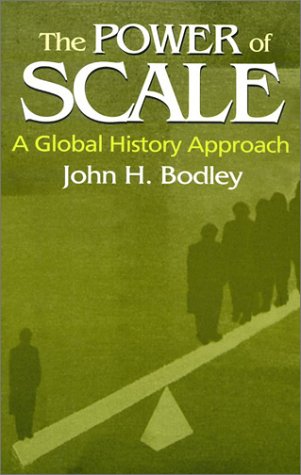
The Power of Scale

(2003) John Bodley


Bodley distinguishes two broad streams, or perspectives, in sociology – and claims that the model he presents in Power of Scale bridges them. One is the “interpretive, symbolic or postmodern” approach. This view, using Bodley’s example of feudal Southeast Asia, “emphasiz[es] cultural meanings and symbolic views … describ[ing] political rulers as benevolent figureheads who were primarily concerned with building temples, hosting ritual spectacles, and protecting the populace”. Under this account, I suppose, Bodley subsumes the views of those who hold that inequitable distribution of wealth is something of a necessary evil towards greater goals like the Hubble Space Telescope, Le Louvre, and the Great Pyramid of Giza. Continue reading The Power of Scale
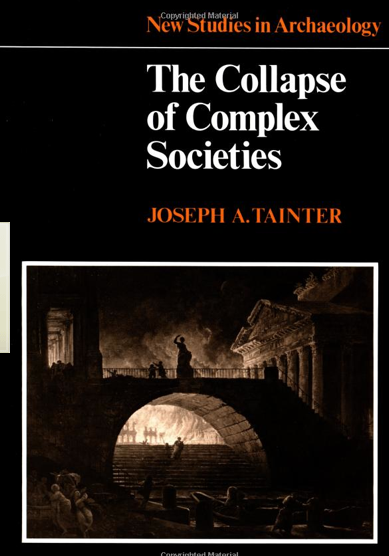
The Collapse of Complex Societes

(1989) Joseph A. Tainter

Tainter presents a detailed review of the major theories on societal collapse.  Through appeal to diminishing marginal returns on complexity, Tainter takes a pseudo-economic line to argue that decay is inevitably in the cards for any complex society.  Unfortunately, little attempt is made to constrain the notion of ‘complexity’.  In reference to the prospect(s) for modern society, one of Tainter’s more interesting observations is that complex societies that exist as islands in a sea of barbarism tend to collapse suddenly and dramatically, while those that exist amongst estimable competitors tend to undergo long, drawn-out decay as power is slowly but surely usurped.  Rather than the desperate bank-runs and grocery-store pillages envisaged by some, I would not be surprised if Tainter envisages a less catastrophic 21st Century in which the United States and Europe slowly deteriorate into a backwater of China.

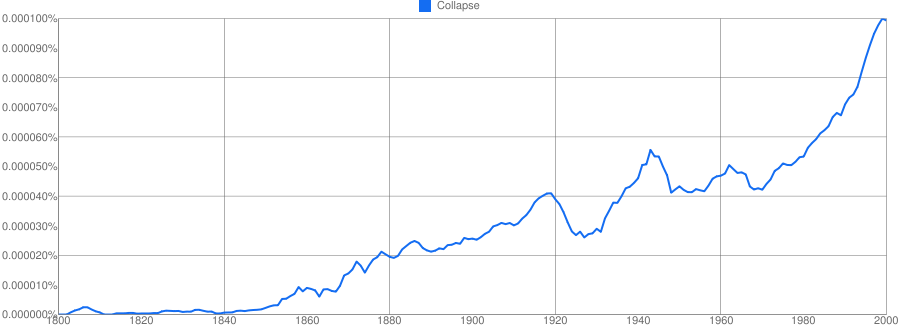
Talk of collapse is becoming increasingly fashionable, as is starkly illustrated by analysis of the word ‘collapse’ in English literature: (using the on-line database at http://www.culturomics.org/)

Relative occurrence of the word 'collapse' in a large sample of English books

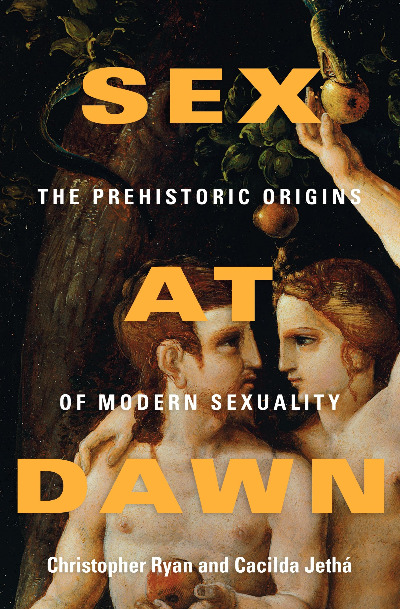
Sex at Dawn

(2010) Christopher Ryan & Cacilda Jethá

So.

So this is a rather ballsy work.  In varying depth, Ryan & Jethá aggressively attack several scientific consensuses, all orbiting within the broad ambit of human sexuality.  A light-hearted writing style makes this a highly accessible work.  Below, I focus on some of the key assertions and arguments of interest.

Primary amongst the traditional views attacked, and the books main target, is the idea that humans evolved from a monogamist prehistory – a period the authors peg as the 200,000 years immediately prior to agriculture and writing. (It is interesting to note how this disparate pair of technologies is often conjoined by use of this sense of the term).  In strong contrast to todays western nuclear family, the authors posit that “the ‘natural’ family structure of our species” is one that enjoys “easy acceptance between adults and unrelated children, the diffuse nurturing found […] where children refer to all men as father and all women as mother, […] small and isolated enough to safely assume the kindness of strangers, where overlapping sexual relationships leave genetic paternity unknowable and of little consequence …”.  The modern pair-bond is painted as a distortion brought about by recent transition to sedentary agriculture. Continue reading Sex at Dawn

The Limits of Power

(2008) Andrew Bacevich

Content. Draws heavily on the thought of Karl Paul Reinhold Niebuhr. America faces impediments on (i) cultural (profligacy leads to deficits and resource dependence); (ii) political; and (iii) military fronts. Much-needed focus is brought to bear on the notion that military commitment can bring about economic growth, à la Nitze’s  (1950) NSC-68. The major novel hypothesis is that the quality of senior U.S. military leadership has sharply declined since WWII, and that this is responsible for failures in Iraq and Afghanistan.