Author: Jelte
Thinking, fast and slow
Daniel Kahneman (2011)
 This book didn’t just profoundly affect the way I think about the behaviour of human individuals, it actually affected the way I structure my thinking about the behaviour of human individuals. It’s honestly hard to imagine a walk of life in which Kahneman’s book would not be an invaluable read.
Tilt (2011)
So what’s the potential of renewables, anyway?
Last time I wrote a bit about the outlook for future global oil supplies. Let’s try a similar exercise for renewables.
In 2010, we humans used fossil fuels at an annual rate of 400 EJ (1 exojoule = 10^18 joules), which is equivalent to about 13 TW (1 terawatt = 10^12 watts). In raw thermodynamic terms (ie ignoring the capital costs, and the fact that it takes energy to build and maintain the generating capacity), would renewables be able to replace this? A quick summary of the potential of wind, solar, hydro, wave, tidal, geothermal and biofuel (photosynthesis), based on a recommended book by Vaclav Smil’s:
Wind
About 870 TW of solar radiation is transferred to global wind’s kinetic energy (Peixoto & Oort, 1992). A recent study (Marvel, Kravitz & Caldeira, 2013) finds that, in terms of sheer geophysical potential, “wind turbines placed on Earth’s surface could extract kinetic energy at a rate of at least 400 TW, whereas high-altitude wind power could extract more than 1,800 TW.” Although that all sounds like a lot, the accessible energy 80m above ground is estimated to be in the range of 72 TW (Archer & Jacobson, 2005), but we need to bear in mind that turbines need to stand about 5 rotor diameters apart. Computer simulations of a world where accessible areas are covered by 100m tall 2.5 MW turbines with capacity factors of 20% conclude that it’s possible to harnass a maximum of 78 TW (Lu McElroy & Kiviluoma, 2008). So that’s about six times our current fossil fuel use. Hurrah for wind!
Solar
About 120 PW (1 pentawatt = 10^15 watts) of solar radiation reaches the biosphere, of which about 25 PW is absorbed by land. If we knock out excluded areas like polar- and steep mountain regions we’re left with a usable flux of about 15 PW. So that’s about a thousand times our current fossil fuel use. Hurrah for sun!
Hydro
We at SCENE have mixed feelings about hydro. We love the small stuff, though! The total potential of Earth’s runoff is about 10.5 TW, but only about 15% (WEC, 2007) of this is technically exploitable (before even taking the economics into account). Still, hurrah for small-scale hydro!
Wave
Wind-driven ocean waves have a kinetic energy of some 60 TW, only 3 TW of which is dissipated along coasts. Well, it’s worth a try!
Tidal
Tidal energy amounts to about 3 TW, of which only 60 GW is dissipated in coastal zones. Better than nothing, especially if you’re miles away from the nearest electricity grid. Beats running a generator.
Geothermal
Earth’s geothermal flux is on the order of 42 TW (Sclater, Jaupart & Galson, 1980), but mostly (like 80%) in the form of low-temperature diffuse heat on ocean floor which isn’t going to help us out much. Some (Bertani, 2009) reckon that, by using steam, we can tap into 140 GW by 2050. Worth a try if you’re lucky enough to live near a resource – just look at Iceland (cheapest electricity in the world!)
Biofuel (photosynthesis)
Terrestrial (= on land) photosynthesis proceeds at a rate of about 60 TW, about 3 TW of which currently gets used for energy. Hurrah for plants!
Next time, we’ll start thinking about how much of this renewable resource is realistically available to power human lives.
Peeking at Peak Oil
Kjell Aleklett (2012)
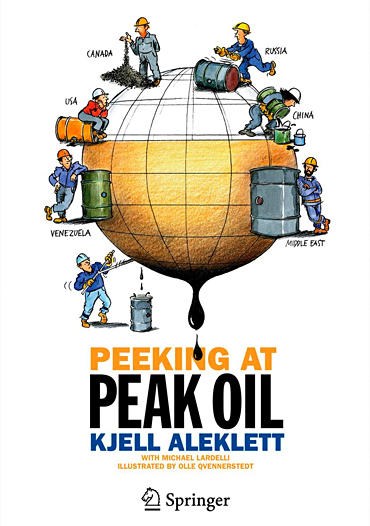 Despite trying hard not to, I really really like this book. Wonderfully illustrated, and written in a clear and unpretentious style, I have no choice but to go on record saying: great book, Kjell. If you read only one book on Peak Oil, this is the one. Read about some of Kjell’s forecasts here.
So What’s The Deal With Unconventional Fuels?
If you’re in any way involved in renewables, it’s becoming increasingly hard to ignore unconventional fuels – oil sands, heavy oil, oil shale, shale oil, coal-to-liquids and gas-to-liquids. It’s becoming evident that a new fault line is opening up between renewables on the one hand, and these high-tech hydrocarbon technologies on the other. Because both require long-term investment and high up-front capital outlays, governments and energy investors alike are increasingly having to make a choice. Because their fate is entwined with that of renewables, I’ve decided to write up a naively short summary of the main unconventional fuels – much of this is based on Kjell Aleklett’s recent and recommended book. Although it’s easy to criticise these technologies on environmental grounds, an equally important question here is, ‘how many millions of barrels of oil a day (Mb/d) can these sources provide?’. Humans currently use about 82 Mb/d, and Kjell’s group argue that global production of conventional oil is dropping by about 4 Mb/d every year. If Kjell’s group is right, then unconventionals will at the very least have to replace that by expanding output by an equivalent amount. If they can’t do that, then the case can be made that remaining liquid hydrocarbon reserves should be used very carefully and strategically to prepare for a low-oil future (by investment in renewables deployment and research, for example), rather than be squandered on consumption goods.
Oil Sands
Also called tar sands. The vast majority of it is mined in Canada’s Alberta province, through old-fashioned strip-mining, as well as cyclic steam stimulation (CSS) and a fancier technique called steam-assisted gravity drainage (SAGD). Both the IEA and Kjell’s group reckon strip-mining and in-situ methods can provide around 3.5 – 5 Mb/d by 2030.
Heavy Oil
Most of this stuff comes from Venezuela’s gigantic Orinoco Belt. Both the IEA and Kjell’s group reckon it’ll account for around 1.5 – 2 Mb/d by 2030.
Oil Shale
A ‘shale’ is a very generic rock type. ‘Oil shale’ is the name given to shale that contains kerogen, which is a catch-all phrase for insoluble hydrocarbon material (astrobiologists find kerogen in meteorites, for example). Unlike oil, kerogen is typically waxy, and needs to be processed into synthetic oil before anyone can truly go around calling it an ‘oil’. Most of it is currently mined in Estonia. The IEA reckons oil shales will contribute up to around 0.3 Mb/d by 2030.
Shale Oil
Shale oil (and shale gas) is what everyone is referring to when they talk about ‘hydraulic fracking’. It’s probably fair to say that this is the most controversial unconventional. The IEA published an estimate of 1 Mb/d by 2035, but opinions differ. Many reckon that shale oil and -gas are the future. Others think it’s a bubble.
Coal-to-Liquids (CTL)
Just what is says. 5.5 Mb/d by 2030, reckon the folks at the US-based National Petroleum Council. Kjell’s group reckon this is way of the mark though, and with the IEA, they put the 2030 forecast closer to 1 Mb/d.
Gas-to-Liquids (GTL)
Just what is says. 0.7 Mb/d by 2030 reckon the IEA, an estimate that Kjell’s group view as hugely optimistic.
Deepwater Oil
It’s probably worth saying a bit about Kjell’s estimates for future deepwater (> 500m depth) oil production as well, as this represents an important flux:
- Gulf of Mexico: 0.8 Mb/d by 2020
- Brasil: 3 Mb/d by 2020
- Angola: 1.64 Mb/d by 2020
- Nigeria: 1.40 Mb/d by 2020
Geography and Trade
Paul Krugman (1991)
 Three classic lectures, looking primarily at the roles of economies of scale and transport costs on regional and international trade.
Projected global electricity sources in 2035
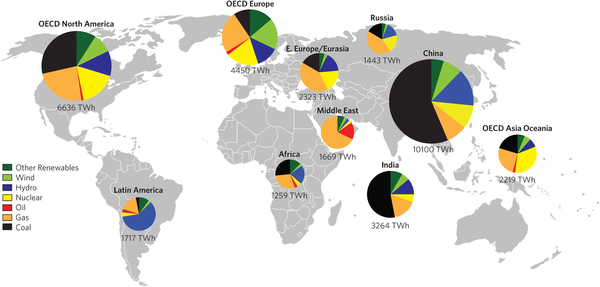
Source: Vivian Scott, Stuart Gilfillan, Nils Markusson, Hannah Chalmers, R. Stuart Haszeldine (2013) ‘Last chance for carbon capture and storage’, Nature Climate Change, 3, pp. 105 – 111.
The Construction of Social Reality
John Searle (1995)
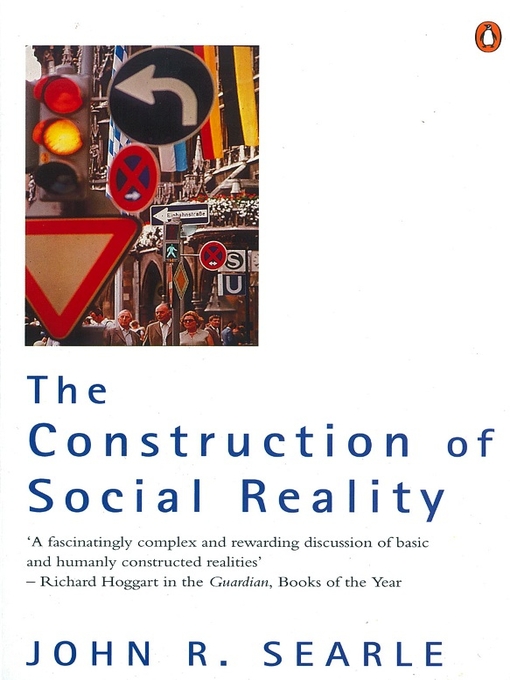 Given the subject matter, John Searle’s The Construction of Social Reality is an accessible book, and well worth reading.
I have some problems with a few of the arguments:
(1) Pre-supposing a realist ontology
Searle explains ‘representation’ as follows (p. 150/151; italics mine): “Human beings have a variety of interconnected ways of having access to and representing features of the world to themselves. These include perception, thought, language, beliefs, and desires as well as pictures, maps diagrams, etc. Just to have a general term I will call these collectively representations.” He then dedicates two entire chapters to the defense of ‘external realism’ in the face of ‘anti-realist’ attacks. He defines ‘external realism’ (p. 150) as the view that “the world (or alternatively reality or the universe [sic]) exists independently of our representations of it.”
So: (i) a notion of representation that relies on the existence of ‘the world’ is set up and implemented. (ii) notions of ‘realism’ and ‘anti-realism’ are set up and implemented that rely on the world existing independently and dependently of representation, respectively. (iii) the case is then made that much of our normal understanding and discourse already presupposes realism, and are unintelligible in it’s absence. (iv) the onus is then shifted onto the shoulders of anti-realists, who are now called on to replace ‘normal background understanding’ with an alternative that would make anti-realism intelligible.
My issue is this: if you’re going to hang the notions of realism and anti-realism on the independence or dependence of representation on ‘the world’, then obviously you’re already buying into a realist ontology – not because of reliance on ‘normal understanding’, but because the very criteria by which you propose to swing the argument already appeal to such a thing as ‘representation’, which in turn appeals to such a thing as ‘the world’.
(2) Ontological objectivity
“[t]he presence of snow or ice near the summit of Mt. Everest is in no way dependent on the existence of human or other sorts of representations.”
“in no way dependent”!? Searle’s own example sits uncomfortably with me. “Snow or ice”, you say? So is this white stuff that I’m pointing to, right here on the summit of Mt. Everest, snow or ice? What’s that you say? “It depends on where we agree to put the referential boundary between snow and ice.” If the disambiguation between snow and ice, between mountains and ridges, etc. requires social agreement – which it does – then something feels wrong to me about the claim above.
Meanwhile, we’re supposed to accept that a $5 bill buried in the ice on top of Mt. Everest is no longer a $5 bill in the absence of representation.
Whether or not there is a mountain, whether or not it has snow or ice near its summit, and whether or not the piece of green paper buried in there is or is not a $5 bill are all questions whose answer – like the answer to any question – relies on social agreement. Maybe I want to say that there is something there in the absence of representation, but that it is impossible to say what it is without representation.
What’s happened here, I think, is that Searle (consciously or unconsciously, I’m not sure which) buys into functionalism: to him, for a certain class of entity, function plays an important role in rendering its identity, in determining what it is, and in some contexts apparently even determines whether or not it is even existent. An ontological distinction is made, with ontologically objective and subjective entities respectively characterised by the absence or presence of function. This is why a $5 bill ceases to be a $5 bill, in his system, if all representation suddenly ceases – it’s simply because for him, $5 bills rely on functional criteria to be called $5 bills, and if those functional criteria are suddenly no longer met (because we wipe out representations, or humans, or both), than voilà – the green piece of paper blowing in the stillness is no longer a $5 bill. Snow, on the other hand, is not called snow by virtue of its role in snowball fights. There would still be snow if snowball fights never existed, qua Searle.
Don’t Afraid It
“Don’t afraid it”, the man cried imploringly, as he worked desperately to steady the craft, legs spread with one bare foot on each edge, sweat already dripping from his body – even though the journey to Lizard Island had not even begun. I have frequently wondered back to those words of his. Â Did he mean that I was not to fear his canoe? Or, rather, did he feel that my very presence there was threatening the natural balance that existed between him and his boat, that I was, as it were, guilty of ‘afraiding his canoe’? That my attitude, my energy – perhaps the weight of the European guilt I carried out there, there on the shores of Lake Malawi – was somehow upsetting the delicate relationship that existed between man and wood, wood and lake, lake and sky?
I only discovered later that the locals knew the island to be cursed.
To be continued.