How Hippie is your Department?

In Ruckus [Vol. 7, Iss. 2, October 2003]

One university. A sample of three-thousand eight-hundred forty-five students. One war. One anti-war resolution. Fourteen different disciplines, from mathematics to drama. What will it be?

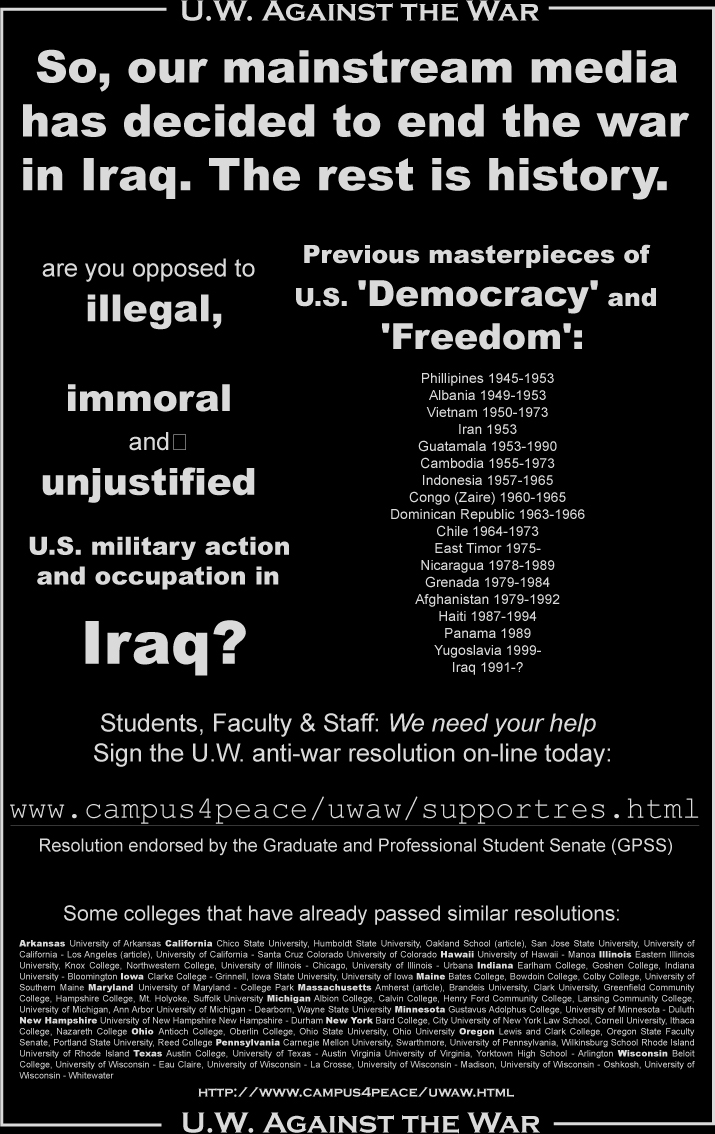
What was done: On February the 12th of this year, the UW’s Graduate Professional Student Senate (GPSS) officially voted to pass a resolution condemning US military action in Iraq. With this, the UW became one of almost 150 universities nationwide to have passed such resolutions. To push for further support, e-mails were sent out to students majoring in fourteen select disciplines, urging them to sign the UW Anti-war Resolution on-line (http://www.campus4peace.net/uwaw/supportres.html). Mathematics, Communication, American Ethnic Studies, Geography, combined Languages, Art, English, Education, Environmental Sciences, History, Drama, Anthropology, Comparative History of Ideas (CHID) and Classics were all hit. More e-mails would have been sent, but the boys at Campus Computing got wind of the operation and threatened to discontinue certain peoples’ MyUW accounts. So the thing was stopped.

How useful are the results? It’s important to realize the limitations of this study. Just because 10.4% of English and Education students signed the resolution, does not mean that only 10.4% of these students were against the war. What it does mean, however, is that 10.4% of these students cared about the matter enough to go on-line and spend time signing a resolution. So the results are useful in that they allow us to compare relative anti-war sentiment at the UW.

What the results were: Check out the charts. An average of 9.6% of students actively responded to the anti-war cry. Most studies had a response pretty close to this, with History, Drama, Anthropology and CHID distinctly towards the higher end. Students in Geography and American Ethnic Studies, on the other hand, weren’t too hot on signing up.

But there were outliers, too. Only 5.7% of Communication students signed, while mathematicians gave by far the lowest response: only 3.3%. At the other end of the spectrum were the students of Classics. Almost a third (32.4%) of the 37 students sampled came out against the war.

Ruckus analysis: Active anti-war sentiment on campus was, on the whole, low. This might come as a surprise, considering the common view of Seattle as a ‘liberal’ and ‘activist’ hangout. The vast majority of students seemed to have little time for extra-mural activities such as signing petitions. It’s not that students lacked an opinion (I mean, everyone has an opinion, right?). That leaves three options: (i) They didn’t care; (ii) They felt they couldn’t make a difference, anyway; or (iii) They were pro-war or undecided. Passivity was a nationwide phenomenon. Consider the fact that during most international days of protest more people walked out in Barcelona, Spain than in the entire US combined! Some protests saw 1.3 million people on the streets of Barcelona – a city with only 1.5 million citizens.

Conclusion: “The sixties”, as one piece of hate-mail I got said, “are not coming back”. Maybe true, until some moron in charge decides to impose the draft again. Ten-thousand years of civilization. Ten-thousand years of the same mistakes. The only thing that seems to have changed, thanks to technology, is the number of deaths for each screw-up. Descensus Averno facilis est.

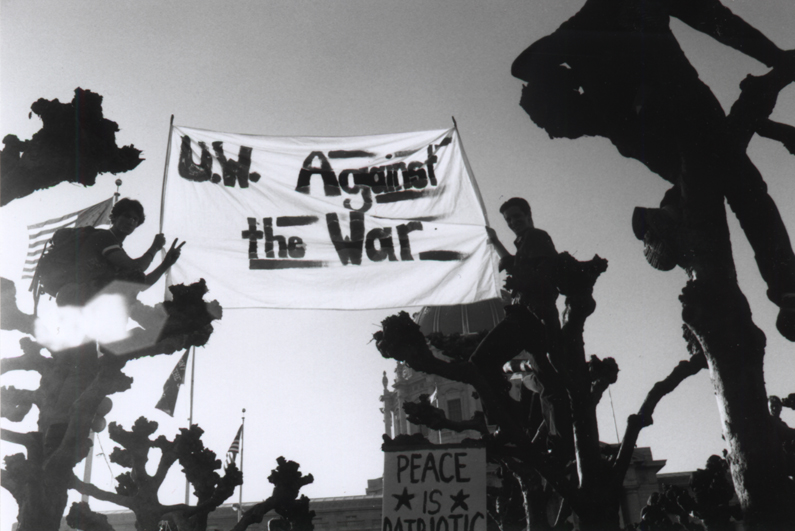
Edward W. Said 1935-2003

In Ruckus [Vol. 7, Iss. 2, October 2003]

“… it hardly needs saying that because the Middle East is now so identified with Great Power politics, oil economies, and the simple-minded dichotomy of freedom-loving, democratic Israel and evil, totalitarian, and terroristic Arabs, the chances of anything like a clear view of what one talks about in talking about the Near East are depressingly small.” – Edward Said, ‘Orientalism’ (1978)

Acclaimed literary critic. Intellectual. Stone-thrower. Anti-American. Peace activist. Renowned musicologist.

Said’s achievements are as diverse as people’s opinions of him. If you were one of the lucky ones who made it into UW’s packed Walker-Ames lecture last spring
(even people with tickets coming from as far as Port Angeles had to be turned back at the door) you’ll be well aware that controversy surrounded Said’s life and work.

The line of people waiting outside the Kane Auditorium was flanked by a row of pro-Israeli (or anti-Palestinian? One forgets.) demonstrators sporting large posters of a younger Said hurling stones, we imagine at some innocent US-engineered and -financed M1 Abraham™ tank on a routine ‘security’ operation. An aggressive half-page essay by three UW academics appeared in The Daily, criticizing the University for bestowing the prestigious invitation to an ‘anti-Semitic’.

Said was born November 1, 1935 in Jerusalem, spending most of his childhood in Cairo, except for several long stays in Palestine. He received his university education at Harvard and Princeton. He was a professor of English and Comparative Literature at Columbia University at the time of his death.

Said’s 1978 book “Orientalism” made waves, and remains his most famous work. A thinly-masked criticism of past Anglo-French imperialism and current US neo-imperialism in the Near- (getting nearer-) East, it was also a groundbreaking look at western attitudes towards Islam.

Whatever your views on the Middle East crisis (err, I mean crises), and American involvement therein, it’s hard to deny that Said has had tremendous influence on both sides of the line. His pro-unity stance on Israel is perhaps too easily mistaken for anti-Zionism. Said was, and is, an inspiration to critical thought and analysis in a world that desperately needs both. The university’s decision to invite such an esteemed but controversial speaker at such a volatile time deserves nothing less than our admiration. Controversy, after all, is probably the unacknowledged driving force behind everything from civil liberties to democracy.

Edward Said died of leukemia at the age of 67 on Wednesday the 24th of September.

“If the knowledge of Orientalism has any meaning, it is in being a reminder of the seductive degradation of knowledge, of any knowledge, anywhere, at any time. Now perhaps more than before.” -Edward Said, 1978

Country Focus: Colombia

In Ruckus [Vol. 7, Iss. 2, October 2003]

This month’s country focus is on Colombia. Yeah, yeah, I know you’re reading a progressive newspaper and I realize that you therefore belong to that small group of citizens who actually care about stuff and I understand that as a result you’ve probably already heard about Plan Colombia and how your government is spraying industrial quantities of herbicide – whose chemical constituents the State Department won’t even disclose – on peasants in rural Colombia, but…

… but that’s peanuts compared to the new plan. Speaking of peanuts, don’t try to grow them in Colombia any time soon. Apparently unsatisfied with the ravages caused by Ultra Glyphosateâ„¢ (brought to us by the same company that gave us – or actually, gave Vietnam, Laos, Cambodia and our Vets – the infamous Agent Orange. Stick with what you know, right?), the State Department has brilliantly conceived of an even more efficient way of pursuing an anti-drug campaign which it’s own analysts are even saying isn’t working. Mycoherbicide fusarium oxysporum formae specialis [f.sp.] erythroxyli. Quite a mouthful. Or rather not. Inevitably dubbed ‘Agent Green’ by opposition groups, Fusarium oxysporum is actually a virulent fungus engineered by the Montana-based Ag/Bio Con, Inc. So the plan is for high altitude drops of this stuff over Colombia to target coca, the raw material for cocaine.

There are a few pesky legal obstacles to overcome, however. Like the fact that the UN Biological and Toxic Weapons Convention technically classifies F.o. as a biological weapon. And the fact that spraying the stuff all over Colombia contradicts several clauses of the Geneva Convention. (These, by the way, are agreements that the US has actually decided to sign. Unlike the 1966 Covenant on Economic, Social and Cultural Rights; the 1979 Convention on the Elimination of Discrimination against Women; certainprotocols of the 1989 Covenant on Civil and Political Rights; the 1989 Convention on the Rights of the Child; the 1997 Kyoto Global Warming Protocol, the 1997 Ottawa Mine Ban Treaty; and the 2002 Rome Statute for the establishment of an International Criminal Court – to name just a few).

There’s more to Colombia than cocaine, of course. Like oil, for example. Los Angeles-based Occidental Oil has most of that covered. They got their pipelines covered, too. By US-trained right-wing paramilitaries, no less. Then there’s coal. Brought home to a light-switch near you courtesy of the Alabama-based Drummond mining company. They recently got into trouble for allegedly using Death Squads to polish off Colombian trade union leaders, according to an Asian edition of Time Magazine I picked up in Nepal. You see, one of the perks of being the Ruckus International Correspondent is that I actually get to read about this stuff – the story never appeared in the US edition of Time.

Final Fun Fact: Colombia is the third-highestrecipient of US ‘aid’. (What are the first two? Entries open now. Bonus points for telling us why. Send your answers in
to Ruckus by e-mail, post, or hand today. Winners to be announced next month.)

Antiwar Resolution

University of Washington

Student, Staff and Faculty Resolution

(prepared by Jelte Harnmeijer, Nicolas Pinel and Tarek Maassarani)


A Statement Regarding the Threat of War on Iraq

WHEREAS no link whatsoever has been proven between the horrific terrorist attacks of September 11th, 2001 and the government of Iraq, and;

WHEREAS the Bush administration has failed to present a clear and coherent case to the American public and the International Community for the need to intervene militarily in Iraq, and;

WHEREAS many experts, including former United Nations Chief Weapons Inspector Scott Ritter and CIA Director George Tenet, have disputed the President’s contention that Iraq poses an immediate and veritable threat to the United States, and;

WHEREAS diplomatic solutions for deterrence of proliferation of Weapons of Mass Destruction in Iraq have not been exhausted, and the International Community has expressed reservations about the need for a military attack, and;

WHEREAS a war with Iraq may exacerbate the resentment in the Middle East and elsewhere towards the United States’ Government and it’s peoples, increasing the probability of attacks by radical vengeful groups on American citizens at home and abroad, and;

WHEREAS a rigorous weapons inspections regime serves the interests of US national security better than pre-emptive strikes, and;

WHEREAS unilateral, pre-emptive strikes against a sovereign nation justified in the name of national security or otherwise will severely hamper efforts at attaining world peace, and;

WHEREAS a war with Iraq would jeopardize the lives of American soldiers as well as innocent Iraqi civilians, who have already suffered enormously under the current Iraqi regime, United Nations sanctions[1], and US/UK bombings, and;

WHEREAS the United States in its condition of global superpower should act justly and responsibly under the highest moral standards, maintain international and domestic policies marked by consistent integrity, and strive to set an example of peaceful coexistence, and;

WHEREAS military spending in the United States has reached unparalleled dimensions, with up to 300 billion tax-payer dollars projected for the 2003 fiscal year[2], while the current economic crisis has raised unemployment and forced budget reductions in social and educational programs nationwide – leading, for instance, to continued tuition increases at UW.

University of Washington Against the War (UWAW). January 27th, 2003.

(1) According to UNICEF estimates, UN economic sanctions have caused the death of over 500,000 Iraqi children between 1991 and 1999.
(2) Reuters reported that some Congressional budget estimates predict that a war on Iraq could cost $200 billion. (Reuters October 1, 2002)

THEREFORE BE IT RESOLVED:

THAT THE COMMUNITY OF THE UNIVERSITY OF WASHINGTON calls for the Government of the United States to work with the International Community, and within the framework of International Law, towards resolving peacefully the current conflict with Iraq, and;

THAT THE COMMUNITY OF THE UNIVERSITY OF WASHINGTON demands that the US Government prioritizes the domestic social and economic problems, and makes judicious and socially minded decisions about budgetary allocations, and;

THAT THE COMMUNITY OF THE UNIVERSITY OF WASHINGTON urges the US Government to adopt and uphold a policy of peace – rather than preemptive military action – in foreign policy planning and implementation.