Africa’s Stolen Revolution: The Story of Moçambique

In Ruckus [Vol. 8, Iss. 3, January 2005] and the Washington Spark

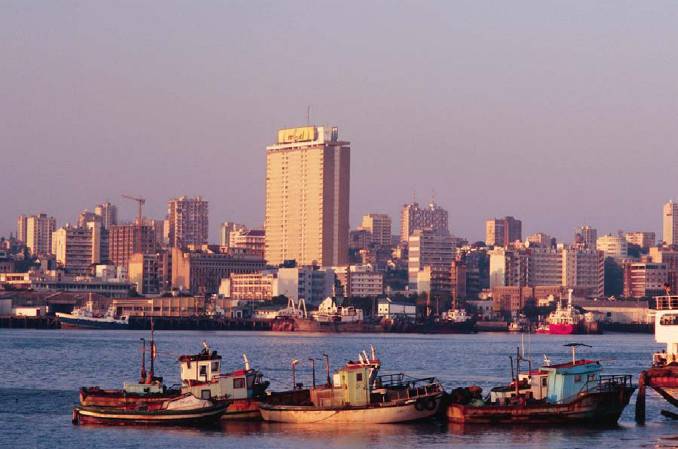
Moçambique is one of those countries that few Americans will ever hear about, and even less will ever get to visit. From our privileged view atop our victorious post-Cold War balcony – built with the tropical hardwood, and carried upon the broken backs, of our brothers and sisters in the Southern lands – we should steal an occasional glance downwards at that continent so easily overlooked: Africa.

As dreams of Revolution become whispers, and whispers transform slowly into words, and over the coming two decades these words, perhaps, start boiling over into actions, we would do well to reflect on the story of Moçambique’s stolen revolution. A revolution that ultimately failed, but not before catalyzing and inspiring the end of white minority rule throughout much of Africa.

The Legacy of Samora Machel

Just over 18 years ago, a Russian-made Tupolev 134 aircraft slammed into the Lebomba mountains in South Africa, near the border with Swaziland and Moçambique. Among the passengers killed were the Moçambiquan president Samora Machel, along with most of his entourage. The cause of the accident, which occurred under highly suspicious circumstances at a time of great tension between Moçambique and Apartheid South Africa, was never resolved. Not surprisingly, Moçambiquans and black South Africans alike pointed the finger of blame squarely at South Africa’s white Apartheid government.

Affectionately known and remembered as “President Samora”, Machel had spearheaded a bloody 10-year revolutionary struggle that eventually led to independence from the Portugese in June 1975. “Of all the things we have done, the most important – the one that history will record as the principal contribution of our generation – is that we understood how to turn the armed
struggle into a Revolution; that we realized that it was essential to create a new mentality to build a new society” said Machel.

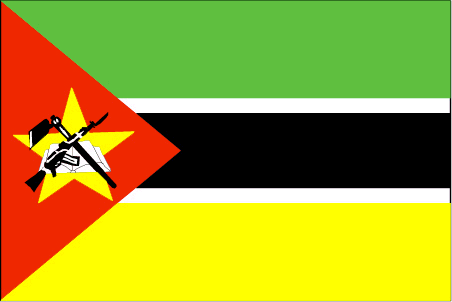
The new Moçambiquan flag donned, amongst a book and a tiller, the icon of an AK-47 rifle – the only flag in the world to do so. The mozambique_flag_largesymbol would prove to be as appropriate for Moçambique’s future as it was for its past. Under Machel’s party, FRELIMO (Front for the Liberation of Moçambique), the country became a springboard for tireless armed resistance against the racist white minority regimes in neighboring Rhodesia and South Africa. Even today, the mere mention of Machel’s name almost anywhere in Africa will be greeted with respect and awe. The Rhodesian and South African governments responded with a brutal campaign designed to undermine the very soul of Moçambiquan livelihood through a front called the Mocambiquan National Resistance (RENAMO). Although most textbooks describe the ensuing onslaught as a civil war, it should be pointed out unequivocally that RENAMO was erected, trained and supplied wholly by foreign agents. Atrocities continued with little pause until FRELIMO jettisoned its Marxist ideology in the early 90s.

Moçambique Today

Today, Moçambique is one of the poorest countries on the planet. Life expectancy at birth stands at an abysmal 38.5 years. In the capital Maputo, massive abandoned cement skyscrapers pepper the skyline, too rickety to inhabit and too expensive to demolish. Beggars, prostitutes and desperate vendors attempt to carve out a meager existence on streets whose names once inspired a feeling of optimism and hope: “Mao Tse Tung Avenue”, “Karl Marx Street” and “Friedrich Engels Drive”. Almost 80% of Moçambique’s 19 million or so citizens live with less than two dollars a day to spend. Demarcated areas strewn with landmines are a common sight along Moçambique’s only –and barely drivable- national road, as are their one-legged and legless victims.

When asked why their country is faring poorly, Moçambiquans almost unanimously invoke government corruption as the primary cause. Even in villages as far as 1000 miles north of Maputo, stories relating the spending sprees of government ministers and their immediate family-members abound. “Our government doesn’t care about us. Corruption is everywhere. It’s a top-down problem.” said Silvinhio, a 26-year old unemployed man living in the coastal village of Vilanculos. His bitterness and anger resonate throughout the country and, indeed, much of the continent.

Moçambique Tomorrow

As Moçambique slowly tries to recover from a history of war, and grapples with floods, famine and corruption, it is hard to see how people keep hope. One UN development expert told me: “This country is finished. Things won’t change. Not in fifty, even one hundred years.” Even for journalists intimately familiar with an unfair world, the human capacity to cope, and smile, in the face of overbearing odds never ceases to amaze. But on a planet forever shrinking, there will come a day when it is people’s capacity to forgive, not cope, to which we will find ourselves appealing.

CAFTA: Here We Go Again

Ruckus’ Guide to Screwing Poor Countries
with Nicolás Pinel, In Ruckus [Vol. 8, Iss. 2, December 2004]

Step 1: Misname your plan.

Give your plan a deceptive name like ‘Free Trade Area’ (FTA) or ‘Free Trade Agreement’. This makes people think your plan is about fair and simple trade, instead of corporate ownership of foreign economies.

Step 2: Decide on which countries to screw.

If possible, select entire regions. The more countries within a region can be amalgamated into a FTA, the better. This prevents countries outside the agreement from starting up their own trade network, outside of your control. The Central American FTA, CAFTA, would apply to the US, Guatamala, El Salvador, Honduras, Nicaragua, Costa Rica, and perhaps the Dominican Republic.

Step 3: Eliminate public opposition.

Unfortunately, the citizens of the Third World are becoming forever less amenable towards FTAs. The good news is that their governments and upper-tier citizens are amongst the few who stand to gain! Get them to imprison, torture and/or kill union leaders first. This instills fears against organizing amongst workers. Students can also be a problem, but university shut-downs and bloody terminations of student protests will put a quick stop to that. You might want to consider setting up special training camps to help the local militia quench popular uprisings. The folks at the Western Hemisphere Institute for Security Cooperation (formerly the School of the Americas) at Fort Benning, Georgia are the ones to contact.

Step 4: Buy up essential social services.

FTA agreements go hand-in-hand with privatization. Get your multinational corporations to buy up essential services like electricity, telecommunications, water, and so on. Let whatever is left of social welfare, healthcare and education collapse by itself.

Step 5: Leave the rest to history.

Great job! You have successfully opened a new market and acquired a source of cheap labor. No more worrying about environmental restrictions, human rights, safe working conditions, minimum wages, retirement funds, and so on.


The need exists for a new breed of lexicographers who can help decipher and catalogue the language of global politics in the dictionary of doublespeak. Therein would rest the new meanings of traditional terms as used by international bureaucrats and policy makers. Democracy could be defined as “form of government practiced by individuals who are easily manipulated, and characterized by imposed dogmatism and covert control of the institutions by special private interests”. Morality as a “system of beliefs devoid of logical consistency and barren of all connection with reality, frequently used to rally up people for political benefit”. Finally, free, when used in conjunction with trade, could be explained as “state of oppressive control over small-scale economies by transnational economic conglomerates aided by policies ignorant of their own past nefarious consequences”.

This last entry would cite as an example the Dominican Republic-Central American Free Trade Agreement (DR-CAFTA), likely to be considered by the US Congress in the near future.

Labor unions and social groups, as well as numerous policy makers have expressed opposition to the free trade agreement from its inception on January 27, 2003, with an estimated 10,000 people protesting the opening meetings in Costa Rica[1]. On November 13th of this year, the Committee in Solidarity with the People of El Salvador (CISPES), and the Community Alliance for Global Justice (CAGJ – Seattle), brought to Seattle some of the opposition voices as part of the “Derail CAFTA Northwest Tour.” Speakers included Angelica Morales from the Border Women Workers’ Committee, Mexico; Carmelina Contreras de Guzman, General Secretary of the Salvadoran Union of Telecommunication Workers; and Lynne Dodson, president of the Seattle Community College Federation of Teachers.

DR-CAFTA was signed in May 2004 by the trade representatives of the US and the Central American countries of Costa Rica, El Salvador, Guatemala, Honduras and Nicaragua. The Dominican Republic subsequently joined the group on August 5th. Approval by the corresponding legislative assemblies is pending for DR-CAFTA to come into effect.

As a proposed extension of the North American Free Trade Agreement (NAFTA), DR-CAFTA negotiators should have learned from the experiences of its predecessor. Free trade agreements are touted by their proponents as the conduits to prosperity and development[2]. While Robert Zoellick, the US Trade Representative has argued for the value of NAFTA in the development of the economy of Mexico, Canada, and the US[3], a study by the Economic Policy Institute released in November 2003 reveals that the net effect of NAFTA has been multilateral economic and social services deterioration[4].

Nearly 900,000 US jobs have been lost to low-wage laborers and manufacturers in Mexico. Mexican farmers have been driven into poverty by the dumping of US corn. Canadians have seen a drop in social investment due to intense economic competition with the US.

The growth of the US trade deficit accelerated with the inception of NAFTA. The increases in US imports from Canada and Mexico due to the liberalization of the markets greatly surpasses the rise in exports to these two countries (by 20.1% and 100.1% respectively). Yet, CAFTA is being promoted by its supporters onthe same failed promises and faulty logic that engendered NAFTA twelve years ago.

One of the sectors poised to take a potentially deadly blow from the liberalization of the local economies is agriculture. As in NAFTA, CAFTA countries will be victims of the dumping of heavily subsidized crops from the US. Rice farmers in Costa Rica fear the flood of Californian rice, a product that received $1.3 billion in subsidies last year[5]. Honduras, staying ahead of the game, decided to eliminate rice quotas in the early 1990’s. The market was flooded by US rice, and the number of local rice producers has decreased from circa 25,000 to 2,000[6]. Under CAFTA, provisions for bringing down rice import quotas have been negotiated, but there are no provisions addressing governmental subsidies to this sector.

From a self-centered position, it would appear that a free-trade agreement allowing us to export the overflow of subsidized crops into other countries would be a benefit to the US economy. However, more than three quarters of all agricultural subsidies in the US are received by only 10% of all farmers. Moreover, the 10% who receive these subsidies are generally those farmers practicing large, industrial-scale agriculture; smaller-scale local family farms are excluded from these benefits[7].

Beyond subsidies, CAFTA appears to be the first free trade agreement that, by mandate, excludes fairly traded products. A provision in Chapter 3 on National Treatment and Market Access for Goods prohibits allocating product quotas to non-governmental organizations and producer groups. This means that products such as fair trade coffee would not be allowed to participate in the allotted quotas[8].

A fundamental component of free trade agreements is the opening of local industries, social services and public utilities to privatization. Carmelina Contreras de Guzmán described the experiences of her co-workers in a Salvadoran telecommunications company as it was privatized to Telecom France in 1998. 500 employees, including most of the union leaders, were laid off in an effort to make the national company attractive to foreign firms. During its history as a private company, first as part of Telecom France, and subsequently as a part of American Mobil (a Telemex subsidiary), roughly 5700 jobs have been eliminated from the industry.

One of Lynne Dodson’s objections to CAFTA cited the disregard of free trade agreements for democracy and education, and their exclusive focus on profits. Her concerns are justified. CAFTA extends NAFTA’s Chapter 11 provision allowing private companies to sue local governments over policies that are perceived to interfere with profit making (the latter perceived by companies as their fundamental “right”), such as “barriers to trade”, even when such policies are aimed at protecting the environment or at developing social infrastructure[9].

CAFTA, as a good pupil, surpasses its mentor. While NAFTA mandates (at least in theory) that the participant countries adhere to international standards of labor laws, CAFTA asks merely that the countries enforce their own standards. In Central America, labor laws are usually well below international standards. Trade agreements are an appropriate occasion for demanding that the parties rise to the highest political, social, and environmental standards possible in order to receive the perceived economic benefits of trade. In contrast, the approach delineated in CAFTA reflects a disregard and lack of concern for the human components of the trade process.

Authors from the CATO institute have touted CAFTA as a potential “powerful tool for promoting peace, stability, and democracy in the region”[10]. Two crevasses can be found in their logic.

First, informed by history, we know that free trade agreements lead to the degradation of social infrastructure, environmental quality, and workplace conditions as the assets and revenues of the countries flow into the pockets of private companies. With surges in poverty, and patent injustices peace and stability grow improbable. This can be illustrated by CAFTA’s provision
to impose intellectual property rights laws on drugs. In so doing, generic drugs would become inaccessible to Central American patients. Also, patent rights over new plant varieties would destroy the millenary practice of seed-saving by farmers, and would pave the way for the creation of agricultural monopolies by seed-producing companies (potentially forcing GM foods without public input on Central American markets). Furthermore, when superior legal powers are given to multinational corporations rather than to the voice of the people, and the level of social well-being is dictated by profit, democracy in the traditional sense becomes unattainable.

Second, free trade is not free. Free trade can be the means to stability, justice, and democracy. But it must be truly free. It must be free of manipulation of the markets by special interests and powerful economic conglomerates. It must be free of protectionist measures disguised under the cloak of intellectual property rights that guarantee a monopoly of markets for transnational corporations. It must be free of the one-sided demands for liberalization. Free trade must maintain the freedom of the people to make trade decisions according to their economic, social, and cultural values. It must ensure that the trading field is as leveled as possible, so that ten drops of sweat are paid their worth, regardless of who sweated them. When free trade reincorporates the true meaning of free, only then will it become fair, and serve as a “valuable tool for development and prosperity”.

References

1 http://www.ftaareferendum.org/nyc/Current/ElSalvador.html

2 http://www.ustr.gov/Document_Library/Press_Releases/2004/August/USTR_Zoellick_Statement_at_Signing_of_U.S.-D.R.-Central_America_FTA.html

3 http://www.mac.doc.gov/nafta/sp-may8.html

4 http://www.epinet.org/content.cfm/briefingpapers_bp147

5 http://www.latimes.com/business/la-fi-rice16nov16,1,1014054.story

6 http://www.oxfam.org.uk/press/releases/rice161104.htm

7 http://www.oxfam.org/eng/pr020927_cotton.htm

8 Why We Say No to CAFTA: Analysis of the
Official Text. Raúl Moreno, ed. Bloque Popular Centroamericano,
Alliance for Responsible Trade, Hemispheric Social Alliance. March,
2004.

9 Ibid.

10 Griswold, D. & D. Ikenson. (2001)
The Case for CAFTA: Consolidating Central America’s Freedom
Revolution. Trade Briefing Paper. CATO Institute. www.cato.org
The Rape of Data / Bush vs. Science

with Nicolás Pinel, Tarek Maassarani, Bonnie Chang and Beth! Orcutt
In Flagpole Magazine[March 2004]; Georgetown University Law Magazine; and Ruckus [Vol. 8, Iss. 5, March 2005]

The following article, co-authored by a group of concerned graduate students from the University of Washington and other schools and first published by Flagpole Magazine in Athens, GA, and the Georgetown University Law Magazine, has been adapted for Ruckus. The full paper, with references, is available at www.ruckuscollective.org.

“Science, like any field of endeavor, relies on freedom of inquiry, and one of the hallmarks of that freedom is objectivity. Now more than ever, on issues ranging from climate change to AIDS research to genetic engineering to food additives, government relies on the impartial perspectives of science for guidance.”—President George H.W. Bush, April 23, 1990

As acknowledged by the former President Bush, the role of science in public government, and the importance of objectivity in scientific inquiry, can scarcely be overstated. While democratic governments are responsible for engaging the economic and social value systems that reflect the will of the electorate, it is the acquisition and analysis of scientific data that ultimately gives meaning to this complex activity by grounding value-laden decision-making in concrete reality. Furthermore, when it comes to issues directly affecting national and global welfare—such as climate, health care, and the environment—scientists are especially obligated to provide the public and the government with authoritative judgment and information of the highest quality and credibility. In turn, the executive and legislative branches bear a responsibility to act in a manner respecting scientific recommendations.

One stated goal of science is to lift the shroud of subjectivity that cloaks the world around us. Scientific truth comes into existence by minimizing – and ideally eliminating – the role of the very agent uncovering it. Science strives to be a truly universal language that is infinitely transferable across boundaries of culture, language, personality and partisanship, a construct that aims to avoid, by its very definition, room for reinterpretation – political or otherwise. Nowhere is the sacrosanctity of science more relevant than in the fields of health and ecology, two spheres of concern that often stand in the way of “free market” policies and their aggressive proponents.

Unfortunately, these imperatives are not being respected by the present American government. In this article we set out to show, through examples drawn from recent policy proposals and implementations, that the current U.S. administration is actively and effectively reducing solid science into a political tool through a series of determined maneuvers that undermine the vital relationship between science and public policy.

The authors, all graduate students intimately involved with scientific research and/or legal studies, feel compelled to speak out against what we perceive as growing trends of misconduct at the national executive level. Below, we summarize crucial sections from findings in reports published in February 2004 by the National Research Council and the Union of Concerned Scientists, the latter a group of more than 100,000 concerned citizens and sixty imminent scientists—including Nobel laureates, medical experts, former federal agency directors, and university chairs and presidents—who have voiced concern about the misuse of science by the current Bush administration.

Climate change: Controversializing the uncontroversial

The Bush administration has consistently dismissed years of accumulated evidence that clearly show the nefarious effects of industrial activities on the ecosphere. In the first year of the Bush administration, the National Academy of Sciences (NAS) was called on to review the available data regarding climate change and the contribution of humankind to global warming. The resultant report expressed strong agreement with the views of the Intergovernmental Panel on Climate Change (IPCC), a group of more than two thousand international climate researchers established in 1988 under the auspices of the United Nations Environment Program. Both the NAS report and the IPCC acknowledge a trend towards warmer average global temperatures in the last few decades, and point the finger of blame largely at fossil fuel combustion. However, simply because the vast majority of scientists agree does not mean that consensus has been reached—or so goes the logic of the current White House denizens.

In September 2002, the Environmental Protection Agency (EPA) was asked by the White House to remove an entire section on climate change from their annual air pollution report. White House officials, with no scientific training whatsoever, attempted to edit the 2003 EPA Report on the Environment by introducing qualifiers that added fabricated uncertainty to well-established facts. It was this attempt by the Bush administration at manipulating the scientific process within a federal agency that lead to the resignation of EPA Director Christine Todd Whitman in June 2003.

Support from special interest groups has created a false impression of uncertainty. Far from acknowledging the conclusions reached by the majority of experts, the Bush administration has proclaimed that uncertainty about the relevance of human activities in climate change remains impossibly large, and that consequently any policy regulating greenhouse gas emissions lacks justification. The perceived uncertainty stems from a single published review of cherry-picked data and unsupported extrapolations. The review, underwritten by the American Petroleum Institute, and authored by individuals with well-established connections to the oil industry, is frequently cited by opponents of greenhouse emission control and by supporters of White House policies, despite having been contested and criticized repeatedly by the scientific community. By overlooking results derived from decades of research and focusing only on those that support its political agenda—or those of the oil industry—the Bush administration has blatantly manipulated the process of scientific debate to justify policies benefiting industry groups at the expense of the common public interest.

With this background of manufactured uncertainty on global warming, it has become easier to relax emissions control rules governing coal-fueled power plants, and to promote low efficiency, high emission standards for automobiles. Strategies for control of air pollution by the Bush administration have consisted mainly of voluntary reduction by polluters.

Regulations on greenhouse gas emissions are being eased for oil operations in Alaska, where the release of nitrogen oxide from oil fields now exceeds that of the Washington D.C. metropolitan area. Downplaying the imminence of human-caused climate change limits the motivation for development of ‘cleaner’ energy sources, thereby perpetuating US dependence on fossil fuels. The consequences of this are, of course, all too evident today.

The White House has refused to accept the reality of global warming even when identified by the US Defense Department as a significant future threat to national security. In an October 2003 report commissioned by the influential defense advisor Andrew Marshall, the effects of catastrophic global warming on global population patterns and resource distribution are listed as imminent threats to the US. The Bush administration suppressed the report for four months. It was finally leaked in February 2004 to the UK newspaper The Observer. Nonetheless, the only US newspaper to report this story was the Kansas Morning Star, three days after its original appearance. The authors of the report called for global warming to be considered a serious threat deserving immediate attention and action.

At the time this article was written, the Bush administration had not yet acknowledged the Pentagon-commissioned report. Perhaps the White House staff was too preoccupied with their then-current task: requesting exemptions to the Montreal Protocol on the release of methyl bromide, the most powerful ozone-depleting chemical still in widespread use.

Wanted: Scientific experts—no prior experience necessary

Traditionally, the US federal government has avoided overt bias by relying on the nominations of agency staff who, in conjunction with independent outside advice, favor candidates recognized for their scientific expertise and reputation as leaders in their respective fields. The Bush administration, however, has repeatedly selected candidates with questionable credentials for advisory positions, used ‘political litmus tests’ during the interview process, and favored candidates put forward by industry lobbyists over those recommended by its own federal agencies. Needless to say, executives from these industries are often large campaign contributors. Representative examples of the above include the rejection of staff-selected nominees for an Advisory Committee on Childhood Lead Poisoning Prevention by Tommy Thompson, then-secretary of Health and Human Services. Five individuals, all distinguished by their opposition to the tightening of the federal lead poisoning standard, were selected instead. And then there’s the appointment of Dr. W. David Hager, an obstetrician-gynecologist and conservative religious activist with scant credentials and highly partisan political views, to the Food and Drug Adiministration’s Reproductive Health Advisory Committee. Dr. Hager’s refusal to prescribe contraceptives to unmarried women perhaps best elucidates his suitability for a leading staff position on a committee that advises on such issues as abortion, contraceptives, and hormone replacement therapy.

The environment: Now you see it, now you don’t

The status of small populations of species suspected of being threatened with extinction is commonly assessed using mathematical population modeling. The Bush administration has actively fought in court to circumvent the use of this technique, and has supported numerous pending amendments before Congress that would make it harder to list threatened species. Since 2001, only 25 new species—the lowest number since the Endangered Species Act was implemented in 1967—have come to be listed under the Act, every single one under court order. One of the relatively-publicized examples of the Bush administration distorting or suppressing the findings of its own environmental agencies to further its political agenda is provided by the case of the management of the Missouri River. There, ten years worth of accumulated scientific work was discarded because, according to the recently-retired supervisor of the project in 2004, “our findings don’t match up with what they want to hear [and] they are putting a new team on the job who will give them what they want.”

Terrorists, scientists — what’s the difference?

When Congress created the National Nuclear Security Administration—the agency responsible for maintaining and designing the nation’s nuclear weaponry—in 2000, an independent advisory committee was also established to offer expert opinion. This external technical committee was staffed by distinguished academics with extensive knowledge of nuclear weapons, former government officials, and retired senior military officers. During the first Bush term, after a few of the NNSA advisory committee members published articles stating that nuclear weapons designed to destroy deeply buried targets –so called ‘bunker busters’– were not only narrowly effective, but would inevitably produce large quantities of radioactive fallout, the committee was abolished. Coincidentally, the Bush Administration’s 2001 Nuclear Posture Review and FY2004 budgets call for development and targeted funding of these same weapons.

Sexual abstinence: Who are we kidding?

Policies of sexual abstinence were implemented in several African countries in the late 1980s, all with a remarkably consistent and well-documented lack of success. The American Medical Association, the American Academy of Pediatrics, the American Public Health Association, and the American College of Obstetricians and Gynecologists all support comprehensive sex education programs that provide adolescents with information on how to protect themselves against sexually transmitted diseases. During George W. Bush’s 1995-2000 tenure as governor of Texas, the ‘abstinence-only’ state ranked last in the nation in the decline of teen birth rates among 15- to 17-year-old-females. Indeed, there is little disagreement among experts that, far from reducing unwanted pregnancies, abstinence-only programs actually may increase pregnancies in partners of male participants. Laying scientific findings aside, the Bush administration has consistently promoted abstinence programs as its preferred means of HIV prevention. A like-minded Congress approved over $120 million for domestic abstinence programs in its fiscal year 2003 budget, $50 million of which was connected to the U.S. Welfare Reform Act and to programs that teach that a “mutually faithful monogamous relationship in the context of marriage is the expected standard of human sexual activity.” Particular mention should also be made here of the Bush administration’s decision to reroute funding from the independent “Global Fund to Fight AIDS, Tuberculosis and Malaria” to the new abstinence-focused “President’s Emergency Plan for AIDS Relief.”

Upsetting the foundation

Science, like any other academic discipline, rests on a foundation of trust. Our work is built on the pillars erected by those before us, and we depend on their soundness. Falsification, fabrication, and disregard—even when imposed by external forces—are the loose bricks that can collapse years, or even lifetimes, of effort and resources. Unfettered information is the lifeblood of intellectual freedom, critical thinking, and political, social, and— yes—spiritual progress. By suppressing or distorting the information underlying the proper functioning of our society, the current US federal government is failing in its obligation towards the scientific community and the larger public who rely on well-grounded public policy decision-making, free from the damaging distortions of political persuasion.

Adversiting: the Biggest Mind-Fuck Ever

In Ruckus [Vol. 7, Iss. 5, March 2004]

An average of three-thousand commercial messages a day. Never before in the twisted and irredeemable history of mankind have our minds been confronted with such a gargantuan experiment in psychology as advertising. Never before have our little brains had to digest, sort, filter and discard such a constant barrage of non-information. Or, more accurately, ‘anti-information’. Let’s face it: advertisements are mostly lies.

You probably don’t even notice the way the volume jumps up 20% on your TV each time the ads come on, or the way the colors suddenly become more saturated and brighter (just like that new brand of washing powder you’ve really been meaning to try out!). Your kids, on the other hand, probably are paying attention. A suite of psychological research has shown convincingly that children – under the age of eight or so – are totally incapable of distinguishing between what constitutes advertising and information. Surely our friends in the PR departments of McDonalds, Coca-Cola and Marlboro would never think to take advantage of that, now wouldthey? Advertising, you may be thinking, is simply part of WesternLifeâ„¢.

But there are many kinds of ads, in many shapes and sizes, and all try to pass themselves off as information. Walk around Yangon, the capital of Myanmar (formerly Burma) at any hour on any day, and you’ll find yourself confronted every five blocks with ear-splitting propaganda exalting the all-round goodwill and general excellence of the corrupt military dictatorship. Outside
Myanmar’s cities, large billboards have happy feel-good slogans like: “People of Myanmar, Unite and Crush All Those who Oppose Our Union!” At least the citizens of Myanmar, thanks to the foresight of their unelected leadership (the elected one is always either in jail or under close house arrest) don’t have to worry about printer cartridge and viagra® spam in their e-mail, since the country boasts exactly zero-point-zero civilian internet connections.

The coin landed trademark-up further north, in the isolated mountain kingdom of Sikkim, where television was introduced in 1999. Lie back and relax. 100% non-interaction guaranteed. Soak up the steady stream of pictures and sounds. Ahhhh, the ultimate source of unidirectional ‘information’ flow. And you wonder how most of the world ends up with such a distorted view of what the Western life – our life, the real life, the good life – is like. “Since 1999, we can watch MTV and many series from America and that tells us a lot about other young people around the world” said 24-year-old Zangmo Tsering, a girl in tight-fitting western clothes, sipping imported beer, that I met outside a nightclub in the tiny Himalayan state. I could barely hear her over the steady ‘oomph’ of raging Dutch techno music in the background, while Kangchenjunga – the world’s third-highest mountain – loomed impassively and undeterred overhead.

Of course, the very same media that are used to subversively and overtly manipulate the minds of the oppressed and consumers alike are also the very same stuff that revolutions, free and critical thinking, and your copy of Ruckus are made of. This is exactly the question we tackle in this month’s issue: where does information end and the mind-f@#king begin?

Is eternal vigilance, then, the true price of ‘freedom’? Is that the lesson to be learnt from the past century, and even more strongly the beginning of the present one? You would do well to note the quotation marksâ„¢. They are forever becoming harder to spot.

In the Shadow of Rachel Corrie

In Ruckus [Vol. 7, Iss. 4, February 2004]

I never met Rachel. Indeed, the first time I ever heard of her was on the day of her death. Today, her name evokes instant recognition with anyone even mildly involved with human rights. Rachel died under an Israeli bulldozer in Palestine.

We hear about deaths every day. 20 000 people die in an earthquake in Iran – “Wow!” “That’s a lot, eh!?”. Seven more US soldiers down in Iraq – “Hey, are we over the September 11 total yet?” (Like faceless statistics? Check out http://www.iraqbodycount.net). I have nothing more to say about how and why Rachel died. I want to talk a little, instead, about how she lived.

Rachel grew up nearby: in the acclaimed hippie hangout of Olympia, Washington. I decided to go there and try to fit a personality to the pretty and determined face I’d seen on pro-Palestinian posters all over the U-District.

Needing to wake up and pull myself together, I decide I might as well do some interviews outside and inside Rachel’s favorite coffee shop. (Not a Starbucks. Rachel hated Starbucks. Ruckus hates Starbucks). “The Evergreen girl? I’ve heard of her …” “I didn’t know her personally, but …”. Most people in Olympia have heard of Rachel. Yet, I was surprised at how few people on the streets knew more than just the bare details. Ignorance and complacency: one of Rachel’s greatest exasperations, and one she shares with activists worldwide. Her death seems to have switched depressingly few people on to the Palestinian-Israeli conflict, even in her hometown.

Hanging around the Capitol Building, pretending to do the tourist thing, my mind filled with thoughts about Rachel. There’s a large statue with the inscription:

“Greater Love

Hath No Man Than This

That A Man

Down His Life

For His Friends”

What made Rachel care? What is it that makes people look through the bullshit, through the constant barrage of SUV ads and FOX-NEWS and CNN and compulsory pledges of allegiance at school?

Is it family? Driving through fields of green to Rachel’s house. A great place to grow up, I think to myself. The kind of place where parents still forget to lock their doors when taking their kids for short hikes through the nearby mountains. I spend some time listening to the unconcerned chatter of water birds in a nearby estuary from the veranda, as Rachel did many times.

Checking out photos of Rachel growing up. Playing naked on the beach. Pink ballerina. Wrestling with her older brother. On top of the World Trade Center with her dad, wind blowing through her hair.

Interviewing her parents. My eyes catch the titles of books and journals on Palestine on the glass coffee table. Books that weren’t lying there a year ago.

It takes me less than 5 minutes to get emotional. Anyway, they’ve had too many professional interviews already. Forget professionalism. Crying together with her mother whilst looking over the last photos ever taken of Rachel. Walking back to the car from her house, having trouble walking straight. I’m not cut out for this job. I’ll stick to stories on countries, not people, I tell myself.

At Rachel’s old school. A project by eleven-year old Rachel in 5th grade makes me smile for the first time in a while: “I want to be a lawyer, a dancer, an actress, a mother, a wife, a children’s author, a distance runner, a poet,
a pianist, a pet store owner, an astronaut, an environmental and humanitarian activist, a psychiatrist, a ballet teacher, and the first woman president.”

Driving back through the foggy streets of downtown Olympia. Students of Rachel’s age playing guitar and singing out of the back of VW busses in parking lots which smell of weed rather than exhaust fumes.

Rachel had a good life. A warm and tight family. She knew she didn’t need to ask permission to go to Palestine, and could always count on support from back home. Not everyone in Gaza or the West Bank has a return ticket.

Understand – Rachel didn’t want to die. She was no suicide bomber. She was a 23-year-old girl who cared about life and people, and would let her mother pay for expensive sushi once in a while. Top marks in school. Serious about life and the things she believed in, but able to let loose with those who knew her. A listener. Unlike the IDF (Israeli Defense Force) bulldoze-operator, she was not “just following orders”. A hero? If that’s what you make of her. It’s what she makes of you that matters. Now perhaps more than ever.

Activism does not mean starting your life from scratch. Activism means thinking about stuff that matters.

“I think it is a good idea for us all to drop everything and devote our lives to making this stop. I don’t think it’s an extremist thing to do anymore. I still really want to dance around to Pat Benatar and have boyfriends and make
comics for my co-workers. But I also want this to stop.” -Rachel Corrie

Country Focus: Tibet

In Ruckus [Vol. 7, Iss. 4, February 2004]

Tibet – the roof of the world. A land of mountains and monks, where crumbling forts larger than the Husky stadium dot the dry landscape. One can explore the icy plateau for weeks, drinking from partially frozen streams, encountering only a handful of yak salt caravans and Tibetans on horseback. An immensely religious place, where the average impoverished Tibetan family still donates a large part of its meager monthly income to the nearest monastery. Once considered the indomitable spiritual center of the world, Tibet is now a buffer zone controlled by China – strategically useful during the sporadic clashes with adjoining India.

Anyone visiting Tibet expecting to find a bloody civil war pitting robed Buddhists with ceremonial swords against wave after human wave of Chinese soldiers will be disappointed. Chances are, in fact, that you wouldn’t see that many Tibetans at all (assuming the border guards even let you in, of course).
A highly successful repopulation campaign has insured that over half of Tibet’s population now consists of ethnic Chinese.

Most businesses are Chinese-owned. Mandarin, not Tibetan, is the compulsory language taught at schools. Banking, newspapers, television, education, and government bureaucracy are all little different from that encountered elsewhere in China.

It is in the countryside, away from the shiny new high-rise buildings and army checkpoints, that one can still taste the true Tibet. Mind you, the authorities are less than enthusiastic about foreign visitors roaming freely outside the neatly designated tourist region centered on Tibet’s former capital – Lhasa. Get caught, and you can expect to have your passport ripped up in front of your eyes and pay your way out on the earliest flight.

Manage to break out of the tourist circle, and you’ll see what all the fuss is about (Ruckus’ international correspondents always travel with two passports, by the way). Graveyards of stumps greet you where Tibet’s majestic forests once stood. Tibet’s turquoise highland lakes, whose effluent provides water for three quarters of our planet’s population, have become chemical dumping grounds. Uranium and Iridium mining operations, the size of Green Lake, scar the shades of purple and yellow. And everywhere are the surviving remains of Buddhist temples and monasteries which once characterized – nay, defined, Tibetan life – now fading into the dust.

Destruction of culture and language, rape of the environment, unsustainable short-term policy making… in short, the Chinese government is doing exactly what ‘capable’ governments have been doing to their weaker neighbors ever since the advent of agriculture. Life, wouldn’t you agree, is largely a matter of perspective?

To Liberate or To Occupy, That is the Question

The Bad Yellow Occupation Version:

October 1950. Some 40 000 PLA (Peoples Liberation Army = Chinese) troops cross the Drichu river into Tibet. A few Tibetans on horseback, wielding outdated muskets, provide negligible resistance. Within days the Chinese occupation of Tibet is complete. Human rights abuses abound! No democracy or freedom! Religious suppression! The CIA sets up a secret camp in Upper Mustang in northern Nepal, training partisan Tibetan freedom fighters. The desperate measure of western goodwill fails.

The Liberation from Evil Western Influence Version:

October 1950. After centuries of oppression, the Tibetan people are finally liberated from the evil clutches of feudal life. The threatening influence of the colonial powers – most notably the US and Britain – can finally be stamped
out. The end of a highly class-based hierarchical society! Equality for all! Long live chairman Mao! The CIA starts training imperialist terrorists over the border in Nepal, but the strength of the people – not to mention helicopter gunships and the help of the corrupt Nepalese government – win the day.

Whatever version you decide to go with, one thing is certain: Nobody noticed. Nobody cared. The world’s attention was focused firmly on Korea, where General MacArthur crossed the 38th parallel on the very same day of the invasion. The well-known mantra of the Buddha of Compassion, Om Mani Pad Ma Hum, is supplanted by Mao Tsetung wan sui.

What about all those peace-loving boys and girls at the United Nations? The matter would have been completely ignored if it wasn’t for an obscure representative from El Salvador bringing the matter to the forefront. (Trust those damn South Americans to always stand up for what’s right instead of focusing on the issues! They’re going to want to design their own trade policies next – imagine!) Thankfully, the Tibet situation was thrust back into obscurity by the British representative to the General Assembly: “the Committee [does] not know exactly what [is] happening in Tibet nor [is] the legal position of the country very clear”. Well, jolly good, that’s the end
of that, then…

The chaos and destruction of the 1966 Cultural Revolution also spread to Tibet, and the consequences of which are still clearly visible today. The revolution translated as a heightened struggle against the remaining old feudal practices. Red Guards roamed the cities and villages, demanding, amongst other things, that: (1) All observance of religious festivals be abolished; (2) People destroy all photos of the Dalai Lama; (3) No one recite prayers; (4) All monasteries and temples – save a handful protected by government – be converted for general public use; and (5) ‘Feudal practices’, which includes throwing parties and exchanging gifts, be abolished.

Ruckus travel advice #001-A(i): “Never, ever, ever photograph military personnel”

Tibet Today

Fifty years is a long time. On the whole, Tibetans are probably better off than Aboriginals in Australia, Hottentots in South Africa and Native Americans in the US. China has proven itself remarkably capable at assimilating new peoples and territories peacefully and quietly – more so than perhaps any other empire in history. Furthermore, the last few centuries in particular have seen the steady export of Chinese culture to all corners of the globe. Chinatowns are blossoming everywhere, from Seattle to Singapore to Sydney. The real question raised by Tibet and its sovereignity, and the Ruckus question of the month, is: would you prefer to live in a world with (1) China; (2) the U.S.; or (3) both simultaneously as the dominant superpower? If it’s any conciliation, it’s unlikely that you’ll have any say in the matter.

That’s Our George Dubbya

In Ruckus [Vol. 7, Iss. 4, February 2004]

George Dubya Bush (a.k.a. ‘Baby Bush’) is one of the best things to have ever happened to this country. Please, give me a chance to elaborate before skipping over to the section on democratic candidates or chucking this month’s copy of Ruckus into the nearest Mixed Paperâ„¢ recycling bin in disgust.


Look – the world has never been more awake! The largest peace protests in history, from Amsterdam to Bangkok to the roof of the Sydney Opera House. A rapidly growing global network of environmentally and morally active citizens. Growing awareness of Western-backed atrocities in the Middle-East and elsewhere. Brazilian airline pilots that dare give US hegemony the finger. Worldwide, people are rethinking the way their lives and their governments are screwing over their brothers and sisters on the other side of the globe. And all largely thanks to Dubya and his buddies!

Alright, people, I realize that traveling today is more dangerous for you than ever before. Hell, even the age-old trick of sticking Canadian flags onto your backpacks isn’t going to help you now! I know Dubya is the first president since Hoover who actually managed to eliminate more jobs than create them. I’m also all too aware that your government is in the red for 3.02 x 10¹² dollars (the fact that I’m forced to resort to scientific notation here should be some indication of how serious the national debt is. Good thing the US$, thanks to Ol’ Dubya, is hardly worth anything anymore, hey!).

So the economy is in shambles, the world hates Americans, the United Nations and everything it stands for has been irreparably raped, your government has started making nukes again, and people will soon start using your famed Greenbacks™ as toilet paper or to get their fireplaces going. And that, of course, is still the good news…

…but please bear with me on this. Voting for some temporary grassroots green-haired spliff-smoking hippie might make you feel real warm and fuzzy inside for four or even – if you’re lucky – eight years. Perfect. Just long-enough for the next brainless right-wing oil-lobby-supported yoyo to take over and finally get rid of those damn Canadians who’ve been clandestinely amassing huge quantities of Biological Weapons right across the border.

(If only we’d found just one Mad WMD Cowâ„¢ in Iraq to appease those damn liberals, eh? Colin Powell: “This CIA satellite photo, taken just 20 miles outside Baghdad, clearly shows a mad cow. Gentleman, we have found the smoking gun” (ecstatic applause). But I digress.)

Dubya is not the root of the problem. I mean, come on, he’s way too backward to deserve any credit for most of the present administration’s blunders. My point is that even electing a whole century-worth of democrats is not going to improve your grandchildren’s lives. (Even if you do somehow manage to stamp out the true legacy of Dubya’s reign, which will lie in the judiciary rather than in the executive or legislative branch. That’s where the power’s really at. Did anyone else notice the Federal, D.C. and other Circuit courts filling up with hard-line conservatives? Under the current system, it’ll take decennia to kick those guys out!)

The problem, rather, lies with the deeply anchored class-based society and suffocating two-party system that today shackles America. An intricate feedback system in which corporate media and atrocious standards of pre-collegiate education intertwine to give the illusion of a full spectrum of ‘democracy’ with just two end-members: republicans and democrats. Right-wing and right-wing without the strawberries. Will the real Gee Dubya please stand up? – George Washington would have been ashamed. Read any of Jefferson’s work and you’ll inevitably find yourself asking: “What the hell happened!?”

Democracy indeed. Vote and forget. You’ve done your duty. Go ahead, spend the equivalent of another presidential term blamelessly shopping for cheap groceries after finishing your daily job at the bank, taking the dog for a walk on Saturdays and cleaning your car on Sundays. While your CO2 is screwing up the planet, the Doleâ„¢ bananas you buy and the Starbucks® latté you sip are destroying the lives of thousands and your government is killing – indirectly or directly, I don’t care – the people upon whose very shoulders your welfare has come to rest.

WAKE THE FUCK UP! DO YOU REALLY BELIEVE YOU DESERVE YOUR FANCY NEW DVD PLAYER BECAUSE YOU WORK HARDER THAN THE REST OF THE WORLD!? HUH!? TRY WAKING UP ON WEEKENDS AT 5 AM AND WALKING 5 MILES BAREFOOT TO YOUR 5 CENTS-AN-HOUR JOB AT THE NIKE® FACTORY OR SPILLING BLOOD FROM YOUR CUT HANDS INTO A CAN OF TUNA IN A CANNING FACTORY, DESPERATE TO MAKE THE QUOTA!

Vote for Dubya. He’s our only hope.

Turning and turning in
the widening gyre

The falcon cannot hear the falconer;

Things fall apart; the centre cannot hold;

Mere anarchy is loosed upon the world,

The blood-dimmed tide is loosed, and everywhere

The ceremony of innocence is drowned;

The best lack all convictions, while the worst

Are full of passionate intensity.

Surely some revelation is at hand;

Surely the Second Coming is at hand.

The Second Coming! Hardly are those words out

When a vast image out of Spiritus Mundi

Troubles my sight: somewhere in sands of the desert

A shape with lion body and the head of a man,

A gaze blank and pitiless as the sun,

Is moving its slow thighs, while all about it

Reel shadows of the indignant desert birds.

The darkness drops again; but now I know

That twenty centuries of stony sleep

Were vexed to nightmare by a rocking cradle,

And what rough beast, its hour come round at last,

Slouches towards Bethlehem to be born?

Y.B. Yeats – “The Second Coming”

DieBold or Die Free?

In Ruckus [Vol. 7, Iss. 3, December 2003]

“If voting could really change things, it would be illegal.”

“Elections are not rocket science. Why is it so hard to get things right! I have never been at any other company that has been so miss [sic] managed.”

[sources: http://chroot.net/s/lists/announce.w3archive/200110/msg00002.html and http://chroot.net/s/lists/support.w3archive/200009/msg00109.html]

A quote from a US supreme court judge? If only… These are just two excerpts out of 15 000 leaked internal memorandums and e-mails originating from Diebold, the company that supplies most of America’s electronic voting machines and will be taking care of your ballots during the upcoming presidential elections. The memos reveal a worrying number of glitches and loopholes for potential tampering, not to mention illegal last-minute hardware changes while voting is already taking place.

Two rebellious students at Swarthmore College got hold of the memos and put them online. The wired world noticed, and started turning its head. Diebold moved to sue along the lines of “The web site you are hosting infringes Diebold’s copyrights because the Diebold Property was reproduced, placed on public display,
and is being distributed from this web site without Diebold’s consent.”

The memos were removed – but not before mirrors were set up at several other universities. Since then, students at MIT, Harvard, Berkeley, Purdue, Amherst, Indiana and Missouri have likewise been forced to remove the offensive memos.

But students worldwide are fighting back – and winning. Forty academic institutions currently actively host the files, including your very own University of Washington (http://students.washington.edu/~jelte/DieBold/Diebold_Memos.tgz).

There are several things at stake here. Apart from the obvious breach of democratic principles, the matter of electronic disobedience is also brought to the forefront. What is theft? What is property? Should universities stand by their students or do the whole corporate thing? With multiple lawsuits now running both ways, expect to hear more soon.

Country Focus: South Africa

In Ruckus [Vol. 7, Iss. 3, December 2003]

In memory of my grandfather, Pieter Christiaan Harnmeijer.

“Some black guy just threw cookies all over me! Now is that dialogue!?”

A dispute in a South African bakery? Nothing quite so exotic – just an exclamation from one of UW’s good ol’ College Republicans during their highly controversial anti-affirmative action cookie sale last month. In case you missed Ruckus’ coverage, the Republicans sold cookies outside the UW HUB with pricing determined by their customer’s skin-color. The show ended in chaos, with angry students ripping up the stall and cops coming out of nowhere. Questions of race run deep, and run everywhere: from 25c cookies for Pacific Islanders on the HUB lawn and boats of sinking Indonesian immigrants in Australia to outbursts of violence against Han Chinese in Singapore.

One country whose mere mention instantly evokes images of racism – even to people who haven’t been there – is South Africa. In April 1994, Nelson Mandela’s African National Congress (ANC) became the first democratically elected party in South Africa’s history. This marked the end of 46 years of white minority rule, or “apartheid”, under the National Party. People of all colors celebrated and sang in all combinations of South Africa’s 14 national languages. The world looked with anticipation towards the unfolding “Rainbow Nation”. Here was a country endowed with the infrastructure, expertise and resources needed to show the world that Africa exists and matters.

Today, almost ten years later, feelings are mixed about South Africa’s future. The years shortly preceding and following majority-rule saw many white families evacuate to commonwealth countries such as England and Australia, taking their wealth and government-subsidized education with them. Today, many South African graduate students prefer to see their future in Europe or America rather than taking part in building the new nation.

Crime is through the roof. Cape Town recently attained the dubious distinction of overtaking Johannesburg as the city with the highest murder rates per capita in the world. About ten women get raped in South Africa in the time it takes you to read this article – the highest per capita incidence in the world. South Africa also has the largest number of people living with HIV/AIDS. Unemployment is massive. “At least [under Apartheid] we had a job. How much is freedom worth without a job?” one of my black friends even said.

South Africa remains one of the richest countries in Africa, thanks mainly to two major discoveries. In 1867 an African shepherd found the first Kimberley diamond. The British Colonial Secretary predicted correctly that “on this rock the future success of South Africa will be built.” In 1886 the first sample of gold-bearing conglomerate was found in the Witwatersrand, now the world’s largest source of gold. Ownership of these resources was the indirect cause of the gruesome 1899-1902 Boer War that pitted the British empire against local settlers of mostly Dutch descent known as ‘Boers’ or ‘Afrikaners’. Tens of thousands of Boer women and children died as concentration camps made their historical debut onto the list of civilization’s advancements.

Affirmative Action

The Affirmative Action schemes implemented and proposed in the US would be described as mild at best when compared to South Africa’s. Want to get into medical school? Very, very hard if you’re a white male. This is bad news for the university, whose degree inevitably loses international standing. Affirmative action has been widely implemented with mixed success in almost every aspect of South African society – from business and industry to the national cricket team.

It’s easy to criticize such policies as unfair or even racist. And they would be, if the world represented a level playing field. But consider the alternative by taking a look at neighboring Zimbabwe, where no such policies were implemented.

Transform yourself, if you will, into the life of a freedom fighter returning home from a ruthless and bloody civil war to an independent Zimbabwe in 1980. Little has changed, and little is to change for almost 20 years. The government has changed color, but businesses and wealth remain largely in the hands of a small and secular group of whites. Until recently, white citizens in Zimbabwe have enjoyed one of the highest living standards in the world. Swimming pools, tennis courts, gardeners and cleaning maids were the status quo in white neighborhoods until President Robert Mugabe’s government commenced its internationally criticized land-reclamation scheme in the late 90s.

The fact is, racism is everywhere. Fancy P.C.-lingo is certainly not going to solve the problem, if it doesn’t make matters worse. The way people talk is not going to change socioeconomic statistics. The University of Washington recently proudly announced that the enrollment of “underrepresented freshman” increased by 12.31%. Sounds good, until you realize that the total number amounts to a mere 447 students, out of a student body of 39136. The army seems to having much better luck with affirmative action, with over 38% of US troops presently in Iraq comprised of ethnic minorities.

The African National Congress (ANC) student rallies I attended in Cape Town remain amongst the most electrifyingpolitical experiences of my life. I was the only white person. Brightlycolored ANC flags filled the third class passenger wagons (largely ignored by Cape Town’s white citizens who travel mostly in first class). Posters of Nelson Mandela and shouts of “amandla!” – “freedom!” – filled the air. Students were instrumental both to the ANC and South Africa’s transition. Many paid with their lives, working for what the apartheid government was quick to brand a “terrorist organization”. Repression breeds revolution. It makes me wonder if we, in our mostly undeserved American comfort, have not let our freedom – real or imagined – tempt us into moral and political passivity…