Author: Jelte
PeakOil UDistrict

Rachel Corrie: An American Conscience

Astrobiology and the Search for Meaning: An African boy’s perspective
in The Astrobiology Newsletter [January 2006]

A Moral Dilemma
I spent most of my life in Southern Africa. Like a grain of Kalahari sand carried in the Okavango River that suddenly finds itself – quite unexpectedly – in the fertile Okavango Delta, the river of life somehow carried me to UW’s Astrobiology Program where I found myself surrounded not by Gemsbok and Fish Eagles but rather by some of the best astrobiological thinkers (and, after three years of national conferences, I confidently count our graduate students amongst these) on the planet.
Memories of my Third World childhood frequently stir me to justify my luxurious existence as a researcher into Earth’s deep past. It is my contention that, within an age that has been aptly coined the ‘anthropocene’, the allocation of resources towards the pursuit of NASA-scale scientific goals requires critical evaluation. The resource-base with which our planet is endowed is limited, a fact that should now be becoming increasingly clear to even the most ardent of industrialists. Indeed, it is arguably exactly the scientists -even more than many of their planetary co-inhabitants- who should be expected to be particularly self-critical in this context, working as they commonly do at the interface between humanity and the natural world. Do we go to Mars, or heed the near-apocalyptical outcries of many environmentalists and invest instead in monitoring our planet’s bio-, geo- and atmosphere through Earth-observation satellite technology?
And then there’s the fact that someone needs to feed scientists such as myself. In return, we can rarely offer more than a vague commitment to the taxpaying public to increase the information content of the universe, largely through the publication of increasingly specialized articles in increasingly unreadable scientific journals.
In Defense of Astrobiology
Peoples of all cultures and times have derived Meaning from pondering the questions that we astrobiologists get paid to answer. Meaning, I contend, is largely a matter of timescale selection. We humans are evolutionarily conditioned to contextualize our experiences within the meagre timescale of a couple of generations at most. In much of the Western world, the dominant trend towards forever increasing individualism further shrinks this ‘window of reality’ to the pitiful lifespan of our own consciousness. Astrobiology certainly provides some refreshing temporal and spatial distance from this.
What is to become of Meaning in the face of an expanding infernal Sun overrunning Earth’s orbit about 4 billion years from now? And is Meaning itself somehow slated to escape the ultimate universe-scale heat-death necessitated by the Second Law of Thermodynamics? With these upcoming events in mind, can a human-catalysed mass-extinction objectively be regarded as A Big Deal? With these thoughts in mind, I return to the microscope on my desk. Looking through the eyepieces, the dark mass of 3.8-billion year old graphitized organic matter still sits quietly, unmoved, waiting.
To find our more about our research into the oldest life on Earth, visit our website.

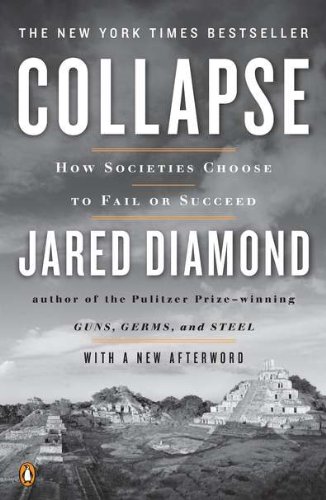
Collapse
Jared Diamond (2005)
 _
_
The new all-American plan for HIV/AIDS in Africa
with Emi Maclean, in The Washington Spark [July 2005]
The announcement of the U.S. President’s Emergency Plan for AIDS Relief (PEPFAR) was met with both eagerness and skepticism when it was first announced by President Bush during the 2003 State of the Union address. The plan promised, for the first time, a commitment to attack the deadly AIDS scourge with more than just measures of prevention. Explicitly, PEPFAR promised $15 billion over five years to provide care and treatment for HIV/AIDS in fifteen severely affected countries. Activists, medical professionals, and the HIV affected expressed concern about what was left unsaid, however. As plans have solidified, at least on the front lines of the epidemic, skepticism has now largely overtaken much of the initial agerness.
Take the 15th International AIDS Conference held in Bangkok, for example. Randall Tobias, still fresh in the newly created shoes of ‘U.S. Global AIDS Coordinator’, faced a furious crowd. The view from the speaker’s platform was largely obscured by a foamy sea of white “HE’S LYING†placards. (Check out his speech and subsequent interview on www.kaisernetwork.org).
Those close to the epidemic are most critical of the plan’s allegiance to industry interests, its threat to comparable multilateral initiatives, and its insistence on forcing a controversial moral agenda.
Sharonann Lynch, at the Health Global Access Project (GAP, www.healthgap.org), typifies the view taken by many experts on both sides of the equator: “What the Office of the Global AIDS Coordinator describes as innovative strategies […] are instead incredibly short-sighted and simplistic.â€

The Big Pharma Agenda
The skepticism of those affected by the disease is not surprising. The Pharmaceutical Research and Manufacterers of America (PhRMA) is the most powerful lobbying group in the U.S., exerting significant influence over the U.S. trade and domestic policy agenda. There have been few attempts to hide Big Pharma influence within PEPFAR. Tobias himself, who was sworn in with the rank of Ambassador in October 2003, was voted “Pharmaceutical Industry CEO of the Year†by the Wall Street Journal in 1995 when he was Chairman, President, and CEO of the pharmaceutical giant Eli Lilly.
One of the most consistent criticisms of PEPFAR is its reliance on patented drugs rather than less expensive generic antiretroviral drugs (ARVs), already proven to be effective and in use in parts of the developing world, including India and Brazil. Health Action International (HAI, www.haiweb.org) founder Wilbert Bannenberg estimates that the branded products required by PEPFAR cost, on average, thrice that of equally good generic alternatives.
Pharmaceutical companies have fought fiercely to prevent the approval of generic drugs for use in the developing world—toughening intellectual property protections in bilateral and multilateral trade agreements and challenging country attempts to produce or distribute generic drugs for their populations. PEPFAR funds can only be used to purchase and distribute drugs that have been approved by the U.S. Food and Drug Administration
(FDA). The Bush administration contends that this is for safety and quality purposes. In 2004, the FDA announced an expedited process to approve some antiretroviral therapies “so that high quality drugs can be made available.â€
However, critics argue that the obstacles posed by intellectual property laws should not delay the use of generic drugs in countries where the AIDS epidemic is raging. “It is the World Health Organization, and not the US Food and Drug Administration, which has the mandate to set international standards for quality, safety, and efficacy†read a Médecins Sans Frontières
statement in May 2004.
One African organization that has been outspokenly critical of PEPFAR is the Nairobi-based Ecumenical Pharmaceutical Network (EPN, www.epnetwork.org). As EPN’s Dr. Eva Ombaka points out, “PEPFAR’s insistence on FDA approval for all medicines purchased and the ‘Buy American’ requirement for medicines other than ARVs, causes needless delay in making life-saving drugs available.â€
EPN’s criticism goes deeper than just inefficiency, however. For one, having different brands of the same drugs leads to wasteful complications for already overburdened healthcare systems. Of further concern is the fate of small domestic industries, since the insistence on FDA-approved drugs will threaten the existence of tried-and-tested drug supply chains. (Many African countries currently locally produce low-cost drugs against opportunistic infections associated with HIV/AIDS). In the long-run, the eventual suspension of PEPFAR may leave a veritable chasm in its wake.

Conclusion
Over the last two decades, Africa has of course not stood limply by in the face of the AIDS pandemic. Unfortunately, PEPFAR is staunchly unilateral, to the extent that it will likely undermine other international and local efforts. Its implementation promotes the extensive use of U.S. skills, personnel and institutions to the detriment of readily available local expertise, often with a greater understanding of relevant issues in their local contexts. “There must be lessons to be learnt locally rather than exporting methods from developed countries,†says Associate Professor Billy Futter in the Faculty of Pharmacy at Rhodes University in South Africa.
Under the circumstances, it’s hard for anyone not to be suspicious of the influence of pharmaceutical giants, who stand to benefit greatly from the arrangement. Mr. Bannenberg is not alone in believing that “Tobias is going for the Big Pharma agenda. What this world really needs is a global collaboration.†Does PEPFAR, then, do more harm than good? “No,†Mr. Bannenberg told the Spark, “we definitely need all the help we can get in Africa.“
Wolfowitz for Africa
In The Washington Spark [June 2005]
Liberal advocacy groups came out forcefully against President Bush’s recent surprise nomination of Paul Wolfowitz as president of the World Bank. Many fear that Mr. Wolfowitz will pursue a policy tainted with U.S. economic and strategic interests, shifting the Bank’s -already contentious- focus away from its’ stated goal to “fight poverty and improve the living standards of people in the developing world”.
With Wolfowitz explicitly laying claim to a policy of “poverty reduction with special focus on Africa”, the Spark set out to uncover African perspectives on the new president of the World Bank.
Behind the World Bank
Amidst the settling dust, the World Bank rose from the still smoking remains of World War II as part of the Bretton Woods Agreement. In much the same breath, the International Monetary Fund (IMF) and the General Agreement on Tariffs and Trade (GATT, now the World Trade Organization or WTO) made their appearance in the global arena.
Despite claims to the contrary, the World Bank runs much like a private corporation. Member countries adopt the effective roles of shareholders, with the number of shares -and votes- based roughly on the size of the country’s economy. Consequently, the U.S. is by far the largest single shareholder, with 16.41 percent of votes, followed by Japan (7.87 percent), Germany (4.49 percent), Britain (4.31 percent), and France (4.31 percent).
As a result of this voting structure, the Bank’s president is traditionally a national of the U.S. Elected for a five-year renewable term, the president chairs meetings of the Board of Directors and is responsible for overall management of the Bank.
Historically, the U.S. Treasury Department, which monitors the Bank’s daily operations and instructs the U.S. executive director how to vote on loans and other issues, was responsible for who occupied the Bank’s driving seat. However, as pointed out by Professor Victor LeVine, a political scientist at the Washington University in St. Louis, Wolfowitz’s nomination was unique in having been imposed by the White House, whilst “the U.S. Treasury was relegated to the cheering section”.
Wolfowitz’s Background
A worried Chofamba Sithole, an outspoken Zimbabwean journalist, told the Spark how Wolfowitz’s background is unmistakably interwoven with U.S. national defense and security. Back in March 2001, Wolfowitz began his third tour at the Defense Department as the 28th Deputy Secretary of Defense. With over thirty years of public service under his belt, mostly in government service under six different Presidents, there were few who doubted his suitability for the post in the Pentagon or White House.
Since September 11th, Wolfowitz has been instrumental in planning the so-called ‘war on terrorism’, including military operations in Afghanistan and Iraq. He has also played an active role in diplomacy, through a plethora of speeches before international audiences.
During his first Pentagon tour as Deputy Assistant Secretary of Defense for Regional Programs from 1977-1980, Wolfowitz led the first major assessment of U.S. strategic interests in the Persian Gulf, a study which spawned the so- called ‘United States Central Command’.
Wolfowitz also initiated the ‘Maritime Pre-positioning Program’, a plan that positioned heavy weapons and ammunition aboard ships in the Persian Gulf region. This plan would form the backbone of the initial U.S. response during Operation Desert Shield 12 years later. Indeed, it was none other than Wolfowitz who succeeded in razing over $50 billion in allied financial support for the Gulf War.
Says Chofamba, “He has in mind precisely the radical reform of the key institutions of global governance to comply with the imperatives of America’s new grand strategy for the post-Cold War world – democratic globalism, otherwise known as neoconservatism.”
So what do Africans think?
He has in mind precisely the radical reform of the key institutions of global governance to comply with the imperatives of America’s new grand strategy for the post-Cold War world – democratic globalism, otherwise known as neoconservatism. – Chofamba Sithole
Understandably, many Africans are worried about Wolfowitz’ undisputable ties with the military-industrial complex. Emira Woods, a fellow at the left-leaning Institute for Policy Studies, said “It’s a slap in the face, it’s a poke
in the eye. It’s bad for the international community in general, and particularly for people already pushed to the brink in poor and marginalised communities,” reported South Africa’s Mail & Guardian in an article entitled: “Wolfowitz: the velocirapter”. Mrs. Woods added that “… the person who was the architect of the corporate-driven plan for Iraq that failed now gets a chance to do that in the rest of the world.”
Many have also questioned Wolfowitz’ credentials, pointing out that he has no experience in banking or finance, and has never worked, studied or written in the field of international development.
Prof. LeVine labels much of the liberal reaction as “reflexive”, preferring instead to take a cautionary stance and defer judgement. He, too, was surprised at the nomination, but draws attention to Wolfowitz’ experience as ambassador to Indonesia. “Although we aught to be skeptical”, he told the Spark, “Wolfowitz may well turn out to be the chameleon I think he is.”
Voting against Occupation: Iraq’s Election Results
with Douglas Whitehead; In Ruckus [Vol. 8, Iss. 4, February 2005]
7,200 candidates, organized into 83 electoral blocs. 75 seperate attacks and 44 killings by the Iraqi Resistance. That’s a lot of democracy, eh? Invasions and corporate interest aside, what were the results of the Iraqi election?
On Sunday, January 30th 2005, Iraq held its first elections since the fall of Saddam Houssein in April 2003. The event was lauded as a major success in mainstream Western media. The election fell ten days after President George W. Bush’s inaugural speech in which he announced, using the familiar neo-conservative buzzwords, that America’s future depends on the success of democracy overseas, and called the election a historic event. Bush added, in light of election-day violence that claimed the lives of over 40 people, that some Iraqis may die while exercising their rights as citizens.
Three concurrent elections took place. The major election was for the 275 member Iraqi National Assembly, the legislative body responsible for drafting Iraq’s permanent constitution and the eventual election of Iraq’s president and prime minister. Elections were also held for local Governorate Councils, as well as for the Kurdish National Assembly in Kurdistan. About 58% of registered voters turned out in Iraq’s late January elections. However, the turnout was far from homogenous amongst Iraq’s diverse ethnic and religious groups. In particular, there was a very low voter turnout amongst Iraq’s Sunni Moslems, with most estimates as low as 9%, in contrast to turnouts of around 70% for other major groups. This is hardly surprising in view of Sunni clerics call for an election boycott in protest at U.S.-led assaults on Sunni-dominated cities. The high voter turnout among Shiites and Kurds is itself also not lacking in controversy. Voters in Shiite areas of Baghdad, for example, faced threats from government officials of withholding food rations unless they signed voter registration cards. Others complained that US troops in cities near Baghdad tried to coerce people into voting. Elsewhere, in Kurdish areas to the North, voters have complained of voting irregularities, such as early closures of polling stations, as well as the peculiar absence of certain Kurdish political parties on the ballots.
The Sunni-Kurdish Split
What are the implications for Iraq’s future government? The fair & balanced people at FOX-NEWS will probably tell you that Iraq consists of lots of Shiites, some Sunnis and some Kurds. We at Ruckus will tell you that, in fact, Iraq ethnically comprises about 75% Arab and 20% Kurdish peoples. (Minorities, such as Assyrians and Turkomans, make up the remaining 5%.) Religiously, Shiite and Sunni Moslems make up 65% and 32% respectively, with the remaining 3% made up largely peoples of Christian faith. The vast majority of Iraqi Kurds adhere to Sunni Islam. Iraq’s Sunni Moslems are strongly split along the Kurd-Arab ethnic division, however. In Iraq’s three predominantly Kurdish provinces in the north, the Kurdish nationalist parties – consisting mainly of the Kurdistan Democratic Party (KDP) and the Patriotic Union of Kurdistan (PUK) – have formed a joint electoral bloc called the Kurdistan Alliance. They have also cunningly amalgamated all nine other Kurdish political factions: the Assyrian National Party, the Chaldean Democratic Union Party, the Democratic House of the Two Rivers Party, the Democratic National Union of Kurdistan, the Kurdistan Democratic Socialist Party, the Kurdish Islamic Union, the Kurdistan Movement of the Peasants and Oppressed, the Kurdistan Toilers Party (Zahmatkeshan) and even the Kurdistan Communist Party.

The Alliance, in other words, campaigned for votes almost exclusively among Kurds, with the main objective of consolidating the region around Kirkuk into the Kurdish sphere and thereby limit the influence of a central Iraqi government. As a result, they stand to control 26% of Iraq’s new Assembly.
Winners and Losers
Iraqis voted largely for parties and leaders of their own ethnicity and religion, giving Shiite parties is massive advantage. Not all Shiites voted for non-secular parties, of course. Yet, in the predominantly Shiite precincts in the south, about four-fifths of votes went towards the religious Shiite United Iraqi Alliance (UIA), giving rise to a final vote for the UIA of 48%.
The UIA’s main components are the sectarian Shiite fundamentalist parties: the pro-Iranian Supreme Council for the Islamic Revolution in Iraq (SCIRI) and the Da’wa Party. Other incorporated bodies include the Badr Organisation, the Central Grouping Party, the Islamic Fayli Grouping in Iraq, Al-Fadilah Islamic Party, the First Democratic National Party, the Islamic Fayli Grouping in Iraq, Iraq’s Future Grouping, the Hezbollah Movement in Iraq, the Justice and Equality Grouping, the Iraqi National Congress, the Islamic al-Dawah Party-Iraq Organisation, the Islamic Master of the Martyrs Movement, the Islamic Task Organisation, and the Islamic Union for Iraqi Turkomans. The current Prime Minister Ayad Allawi’s more secular U.S.-funded Shiite coalition, the Iraqi National Accord (INA), heads a party known as the Iraqi List. The Iraqi List also represents the Council of Iraq’s Notables, the Iraqi Democrats Movement, the Democratic National Awakening Party, the Loyalty to Iraq Grouping and the Iraqi Independents Association. The Iraqi List won a dismal 14% of votes.
It is undeniably the Sunni Arabs who stand to lose most from the current state of Iraqi politics. Anticipating this, an influencial Sunni religious body known as the Association of Muslim Scholars had called for a boycott of the elections. The Association has taken a leading role in representing Sunni Iraqis in the absence of an organized Sunni political movement. The Sunni political vacuum results largely from the banning of former Baath Party officials from the elections. Predictably, then, things did not bode well for the Iraqi Islamic Party, the main Sunni party in Iraq. It was lucky to get eight seats in the Assembly. Some other noteworthy parties and individuals that boycotted the elections were the National Front for the Unity of Iraq, Shaykh Muhammad Jawwad al-Khalisi (Secretary-General of the INCC), Dr. Wamid Jamal Nazmi, the Arab Nationalist Trend Movement, Imam al-Khalisi University, the Democratic Reform Party, the United National Front, the Iraqi Turkoman Front, the Iraqi Christian Democratic Party, the Islamic Bloc in Iraq, the Office of Ayatollah Ahmad al-Husayni al-Baghdadi, the Office of Ayatollah Qasim al-Tai, the Union of Iraqi Jurists, the Higher Committee for Human Rights, and the Iraqi Women’s Association.
Of the roughly 280,000 voters registered outside of the country (roughly 23% of all exiled Iraqis), about 93% voted in the election. The Iraq Out of Country Voting Program (http://www.iraqocv.org) estimates that about 36% of absentee votes went to the United Iraqi Alliance, about 29.6% to the Kurdish Alliance, with around 9% going to the Iraqi List, 4.41% to the Communist Peoples Union, and the rest scattered among the remaining 7,000 or so parties.
Analysis
Even though Interim Prime Minister Allawi has been effectively marginalized by his party’s low turnout, things may still turn out in favor of the United States. SCIRI, the Iranian-backed front-runner within UIA is currently headed by Interim Iraqi Finance Minister Adel Abd al-Mahdi. Al-Mahdi has been a vocal supporter of the privatization of Iraq’s state-owned enterprises, and assured Washington back in December 2004 that he would enact oil-laws that would be “promising to American investors.†The UIA also includes the Iraqi National Congress of one-time U.S. favorite Ahmed Chalabi, whose future in the new Iraqi government will hinge on the ability of the UIA to form a successful coalition.

Conclusions
Questions have to be raised about the election process. Iraqi voters were presented with lists of thousands of political parties to choose from, about which most had little to no knowledge. The country itself was put under lock-down, with extended curfews and closed borders, and no international observers were allowed into the country to monitor the election. What’s more, the election was held under the penumbra of a foreign occupation, a process declared illegitimate by the Hague Convention of 1907, in which no foreign power may make permanent changes to the government of an occupied territory. It is interesting, therefore, that when asked why they came out to vote, most Iraqis (Shiites and Kurds included) answered overwhelmingly that they were voting for the end of the occupation and a return of Iraqi national sovereignty. This hope seems unlikely to be answered. President Bush has given no timeline for the withdrawal of troops from Iraq, and plans are already underway for the construction of four permanent U.S. military bases in the country.
Perhaps most ironic is the fact that, despite all the anti-occupation sentiments among Iraqi voters, the most successful parties thus far are led by people like Abdel Mahdi, a person who announced at a recent press conference that he would open up Iraqi national Oil to foreign investors, (effectively guaranteeing the US a monopoly on Iraqi oil) and Ayad Allawi, the CIA backed prime minister of the occupation government.
The new Iraqi government will have a difficult balancing act on its hands. On the one hand, the new government will have to deal with the United States, who is poised to remain in Iraq indefinitely. On the other hand, the government will face challenges on the domestic front. Sunni Arabs will be grossly underrepresented in the new government. Complicating issues further is the problem of Iran. The leading Shiite cleric, Iranian born Ayatollah al-Sistani,who at one point was at the center of the insurgency against American troops, is one of SCIR’s biggest supporters.
A New York Times article from 1967 on the elections in South Vietnam began circulating over the Internet shortly after the election. It reported that amidst Vietcong terrorism, 83% of South Vietnam’s roughly 6 million voters voted in the election, which then president Johnson saw as an encouraging sign in the establishment of a legitimate democratic government in South Vietnam.
While it may not be appropriate to make such an analogy at this early a stage, the eerie similarity between the media coverage of Iraq and Vietnam could be a sign of bad things to come. The U.S. did not pull out Vietnam until 8 years later, leaving 50,000 American soldiers and millions of Vietnamese civilians dead, as well as three countries in total ruin.
In light of what we learned (or at least, should have learned) from Vietnam, it’s difficult to see the elections as a success without a complete withdrawal of US troops from Iraq. If Vietnam tells us anything, it’s that many more Iraqis, perhaps millions, will “die pursuing their rights as citizens.â€
Turmoil in the Himalayas and the Dawn of a New Era
In Ruckus [Vol. 8, Iss. 4, February 2005]
Nepal, remembered by every ones’ parents as the primary destination for high-altitude, low-cost karma (not to mention hashish) has recently seen the second subduction of its’ government in about as many years. Ruckus investigates what’s up and what’s down on the roof of the world.

Introduction
Precariously sandwiched between the two largest populations on Earth, populations from whose ranks the upcoming century’s global leaders will rise, lies the mountain kingdom of Nepal. It is the author’s opinion that, because of the unique niche Nepal and its turmoil occupy in time and space, events there may well represent nothing less than the opening chapter of a new unwritten volume of global history.
For the first time in recent memory, a popular socialist uprising has been allowed to spawn, grow and blossom without Western interference. The die has been cast, and it is not for lack of interest that there are no WASPs at the table. Rather, it is because Delhi and Beijing have firmly taken their opposing seats and, having become irritated with their bothersome sting, have decided not to let them play.
June 2001: Early Tremors
It is around 9:00 pm on Friday evening on the first day of June 2001 in Kathmandu, Nepal. 29-year old crown prince Dipendra, the Eton-educated heir to the throne, walks room to room in the Narayanhiti Royal Palace where his family is enjoying a social get-together. Slung over his shoulders are an M-16 A2® assault rifle and an Uzi™ submachine gun. Screams and gun-fire ring out, scarcely heard over the merciless clatter of the monsoon rains outside. Minutes after committing patricide, matricide, fratricide and sororicide, the prince completes the brutal ‘-cide’ omnibus by shooting himself in the head.
Shockwaves carrying the news of the royal family’s unexpected slaughter surge through the Himalayan kingdom. All television and radio broadcasting is suspended. Army checkpoints manned by fresh nervous soldiers spring up in remote corners like virgin rhodondendron buds poking through the snowy sheaths of winter. From the slopes of the world’s tallest peaks in the north, to the malaria-infested tropical forests in the south, Nepal’s 24 million-or-so citizens brace for uncertain times. After all, no-one knows better than the Nepalese that tremors often forewarn of larger earthquakes to come.
The Nepalese Peoples War: The Avalanche Begins
Technically, Nepal has been in a state of civil war since February 13th, 1996. Like a slab of melting ice, the insurgents (variably termed ‘Maoists’, ‘Terrorists’ or ‘Republicans’ depending on whom you talk to) are slowly diffusing their control inwards to the political heart of Nepal: Kathmandu Valley. About three quarters of Nepal lies under their control today.
Predictably, the Nepalese government has whole-heartedly embraced the anti-terrorism rubric that has enslaved much of the world since 9/11. Many media commentators have simplistically likened the insurgency in Nepal to the 1970’s Khmer Rouge offensive in Cambodia and the 1980’s and 1990’s Sendero Luminoso attacks in Peru. All derive(d) their support primarily from rural peasantry. As a group of armed self-described Maoists in the Manang region of western Nepal explained to me, their struggle is against the absolute and despotic monarchy, with the express aim of establishing a People’s democracy.
The Maoists I spoke to, however, were not brainwashed killers. They were laborers, farmers, porters; they were fathers and mothers. Indeed, only two facets made them stand out. Firstly, many of them were women. This was surprising in the context of the strongly dichotomous gender relations prevalent throughout Nepal. Secondly, they were heavily armed.
To date, no foreign trekkers have been reported killed in the conflict. However, as noted by Amnesty International and other human rights groups, the ‘encircle-and-kill’ tactics employed by the Nepalese army – borrowed from Chiang Kai-shek’s brutal ‘communist extermination’ methods in China in the 1930s – have led to uncounted civilian deaths.
The Maoists, meanwhile, have implemented carefully orchestrated and highly selective deadly raids against police and army structures, and against key government representatives and supporters.

February 2005: The Political Earthquake?
Following the murder of the highly popular King Birendra in 2001, the throne was occupied by Birendra’s younger brother, successful businessman and now king, Gyanendra. Almost immediately upon rising to power, the latter began to systematically reverse the steps taken by his royal predecessor to mold Nepal’s governance into one based on a democratic parliamentary constitution. He fired the Prime-Minister amidst massive protests in October 2002, only to reinstate him after an 18-month spell of experimental multi-party politics.
The last two years have seen the standard array of collapsed peace talks, broken seize-fires, delayed and cancelled elections, and escalating violence. Recently, on the February 1st of this year, King Gyanendra may have made his last desperate move. In addition to once more sacking the Prime-Minister and instating a brand-new 10-member cabinet, he officially introduced severe restrictions on civil liberties, including freedom of the press, constitutional protection against censorship and rights against preventive detention. (Ruckus prize-question of the month: which other nation also recently… oh, never mind.)
The Future: Aftershock
At the time of writing, the situation in Nepal is far from normal. The King’s grip on the press is tighter than ever. The General Secretary of the Federation of Nepalese Journalists, Bishnu Nisthuri, was arrested on February 5 and its President, Tara Nath Dahal, has taken refuge in the United Nations headquarters in the capital. Many of the journalists who have escaped arrest have gone into hiding. Networks of all the political parties have been rapidly and methodologically dismantled to impede their coordination. One of the largest parties in the recently dissolved government, CPN-UML, has gone entirely underground. Almost all other prominent political leaders are either under house arrest or have been detained.
Finally, in a BBC interview on February 7th, a leader of the now-underground Nepali Congress confided that the displaced government is considering joining hands with the Maoists and launching a mass-movement to unseat the king. Many analysts would now agree that a Revolution in the Himalayas within the upcoming weeks has turned from being near-inconceivable to being near-inevitable. But what will the new day bring?
Afterword
Reader, we quite unexpectedly find ourselves at the door-step of a new era. Outside, over the western horizon, the sun has passed through its’ zenith largely unnoticed and is steadily continuing along its indifferent arc. Soon, the sun will set on the long shadows of over half a millennium of Euro-American dominance. Before the fall of night, let us daringly climb atop the slowly crumbling roof of western civilization and turn our backs on the approaching sunset, with its falsely comforting final rays of warmth.
Now, let us turn our faces into the rising easterly winds and look towards the horizon, where the faint red glow of an approaching dawn is already visible through the binoculars of history. Let us squint our eyes, reader, so that we may perhaps steal an occasional glimpse through the slowly lifting cloud canopy. There, do you see it too? Surely those lands, rising out of the obscurity of time once more, are the vague outlines of China and, a bit further still, India.
Reader, even if we will never be able to adequately prepare ourselves for this new day, let us at least find consolation in having been allowed to gaze upon its birth!

Two views on Hotel Rwanda
with Beth! Orcutt, In Ruckus [Vol. 8, Iss. 4, February 2005]
Two reviews of the movie Hotel Rwanda. One by an enthusiastic yet critical Beth! Orcutt. One by a furious Jelte Harnmeijer. But which is right? Will we ever know? And is there a God, and if so, what does she have to say about Rwanda? Read on for answers to these and other questions.
Review 1: An enthusiastic yet critical Beth! Orcutt
As I stepped past the Amnesty International volunteers crowding the theatre entryway, I wondered to myself how a movie about genocide could possibly be PG-13. Genocide – the crime of all crimes that gets its own pedestal in the halls of International Law for being The Very Worst Thing. How could a movie about annihilation possibly be PG-13?!
Hotel Rwanda captures the unimaginable violence of genocide by telling the true story of a person, an ordinary guy surviving in extraordinary circumstances: Paul Rusesabagina (masterfully played by Don Cheadle), manager of the Hotel Mille Collines in Rwanda’s capital city of Kigali. The circumstances – the opening days of the savage killing of Tutsis by Hutus in Rwanda in 1994. By giving a human face to the conflict, director Terry George (Some Mother’s Son, In the Name of the Father) harnesses extreme anguish to bring the horrors of genocide close to home.
For the gore-seekers out there, the PG-13 rating might be a letdown. You won’t see images of children hacking their neighbors to death with machetes, or of churches packed full of refugees set ablaze – both common occurrences during the 3-month peak of killing in 1994 that claimed the lives of 800,000 Tutsis. (That’s equivalent to nearly 9000 people killed per day for 3 months in an area the size of Massachusetts.) Instead, you’ll suffer the emotional trauma of Paul’s young son who witnesses the killing of a neighbor, coming home covered in blood. You’ll shrink from streets on fire and catch glimpses
of unbelievable fields of corpses through the fog. You’ll be exasperated as you watch the fear of children and the sorrow of mothers as they wait and tremble and cry, only feet away from their executioners.
Cheadle’s portrayal of Paul is premium, elevating the film from the realm of simple humanitarian propaganda into a higher league that incorporates masterful character development. As the film opens, we see Paul as a polished, level-headed and ambitious businessman, hoping to avoid getting involved with any trouble, which he is sure will soon pass. We watch as Paul smoothes trying situations (for instance, being told to choose which family members live or die) by greasing tracks well-worn with successful business dealing (a.k.a bribery). Yet, as time marches along, we witness both the evolution of Paul, as he begins to realize that he has to protect refugees and victims, and the parallel devolution of Paul, as he breaks down under the crushing reality of the violence that has engulfed his world. In this, an ordinary man who understands the workings of power is simultaneously reduced and transformed by recognizing and reconciling with an evil that annihilates his estimation of civilization.
By focusing on the personal aspects of this atrocious violence, however, the broader background of the reality of the genocide is hastily introduced through cliché, biased, and over-generalized one-liners. The generation of Tutsi versus Hutu ideologies is blamed on Belgian colonizers; France is admonished for supporting Hutu Power and supplying them with weapons. While there is an element of truth in these statements, they are poor simplifications for what is a complex and continuing struggle of identity and power. It is unfortunate that Joaquin Phoenix’s character, a Western news cameraman, was on the receiving end of many of these half-truths; his limited yet poignant appearance is jerked along by others’ awkward blanket statements. Even further, parties in the conflict were painted with stereotypical brushes – the advancing Tutsi army was shown as a glorious saving force against the evil Interahamwe Hutu militias. In reality, each side
trailed along a blurry past.
While some aspects of the conflict are glazed over, the film still manages to expose uncomfortable truths. A defining element that transformed this conflict into genocide was the coordinated and deliberate plan of killing, made possible by propaganda spread via the Hutu Power-sponsored radio. As the film opens, an unseen announcer is heard calling for the eradication of the “Tutsi cockroachesâ€. When the Hutu president’s plane is shot down (responsibility for this is still questioned), the announcer is back, initiating the call to “cut down the tall trees†(meaning “kill the Tutsisâ€).
Additionally, the film points an accusatory finger at the inaction of the Western world to save civilian lives. A UN “peace-keeping†General (Nick Nolte) bemoans his orders to not intervene to stop the campaign of violence, claiming that nobody cares what happens in Rwanda because westerners are
racist. The hot-air supporting U.S. and other nations’ offerings of international human rights and humanitarian law is exposed for the sham it is by the display of an unwillingness of State department officials to use the g-word (genocide!) because of the implications: using the g-word would require sending in troops. The director purposefully displayed these sentiments in an effort to open the eyes of people in the West to their guilt in this international affair. There is even a hint of the West’s superficiality when Joaquin Phoenix’s character announces that those who see his footage will say “’Oh, my God, that’s terrible,’ and go on eating their dinners.â€
In reality, the movie may not have gone far enough in implicating the complicity of the West. The UN not only prevented soldiers on the ground from intervening, they actually declined advance warning that atrocities were on the horizon by removing troops from Rwanda. Once it became obvious how gruesome the conflict was becoming, international agents finally arrived on the scene to save the day, only to find that they were setting up refugee camps for the same Hutu killers that were now fleeing an advancing Tutsi army, thus exacerbating an already unmanageable situation. These are just a few examples. Of course, Terry George would likely have had to make Hotel Rwanda Parts 1-5 to tell the whole story.
The limitation for expressing the full range of complexity of the Rwanda genocide is apparent, yet it only slightly detracts from the powerful conveyance of the horror it wreaks. As the world each of us knows becomes increasingly global, the only way to connect our common struggle may be by reducing the unknown through sharing our personal experiences. In this light, Hotel Rwanda speaks volumes to how just one person can change the world.
Review 2: A furious Jelte Harnmeijer
Make no mistake. Hotel Rwanda is a movie about the 1994 genocide in Rwanda written and directed by Westerners for Western audiences. Is there an honest effort to portray real Rwandans? Certainly not if we are to judge this by Don Cheadle’s portrayal of the main character Paul Rusesabagina, although he admittedly deserves merit for playing an exceptionally convincing role as ‘the Westernized African Man’. Just look at Paul, the successful business man with his European clothing and efficiency bringing order and the light of reason to the marauding hoards in Africa’s heart of darkness! How his clean and profitable hotel stands out as an ivory lighthouse to helpless drowning Tutsi victims in a sea of Hutu chaos! Ah, there is hope for Africa after all! Disgusting. If you want to understand genocide, this movie does far more harm than good. Decades of complicated ethnic strife, in a highly volatile region of Africa, doubly underwritten in blood-red ink by German and Belgian colonialism, are cleanly distilled with Hollywood-style efficiency into a dualistic battle that pits evil Hutus against a minority of freedom-loving Tutsis. Most unforgivably, the only mention of Rwanda’s colonial past occurs when we learn that the entire distinction between Tutsis and Hutus was arbitrarily fabricated, on the basis of height, by Belgian colonial administrators. I mean, let’s not give the Africans too much credit in assuming that they can draw their own lines without European assistance, eh!? No, let’s rather leave the drawing of lines and the construction of high-voltage barbed-wire fences and enclosures to the European colonists, who have indeed displayed an uncanny historical aptitude for these activities, not in the least by carving up most of Africa into arbitrary regions neatly compatible with European maps. Oh, and hey, if some of these infinitely thin lines end up dissecting the lives, languages, societies and memories of the inhabitants (the ones not carried off to slavery), and some of the resultant boxes morph into air-tight Colosseums for brewing animosity, then… well, that’s why we have the United Nations, isn’t it? Hah, one of the few redeeming qualities of Hotel Rwanda is its’ relatively accurate account of the impotent role the United Nations played during the Rwandan bloodbath.
Hey, guess what director Terry George and film-writer Keir Pearson, hard as it may be to swallow: IT WAS NOT THE ARRIVAL OF YOUR EUROPEAN ANCESTORS THAT STARTED THE CLOCK OF HISTORY TICKING ON AFRICAN SOIL! Hey, card-carrying members of Western ‘civilization’, listen up! Never mind that, well before your priests and warriors commenced their generous quest to spread history across the globe, people that call themselves Hutus were the original inhabitants of modern-day Rwanda. Never mind that peoples labeled by your historians as Cushites arrived from a region your geographers call the southern Ethiopian highlands at a time your chronologers call the 1300s. Never mind that the new arrivals, who call themselves Tutsis today, were different in almost every respect from the resident Bantu Hutus (African is African, right!?). Never mind that Tutsis clearly and unambiguously maintain a systematic social and political distinction to the present day. Never mind that this pre-existing divide was exploited and widened, but certainly not created, to become the chasm into which Hutus and Tutsis alike have thrown one another to their deaths over the last decennia. Ok, maybe you just want to get a feeling for what life in Rwanda is like? Again, this movie does far more harm than good. Only a handful of scenes were shot in Rwanda’s capital Kigali. Most of the movie was filmed in South Africa, with a largely South African cast. The insights we get into a normal day in Rwanda consist predominantly of scenes showing rich Rwandans mingling on Paul’s freshly sprinkled green lawn and in his fancy fortified house. Somewhat more representatively, there is some drive-by footage of South African slums, but I guess the camera crew was too worried about getting their expensive equipment stolen by people forced to live in tin shacks to actually bother depicting what real Rwandans’ everyday lives are like. How warm and fuzzy we are made to feel when, in one of the final scenes (yes I will spoil it for you!), the persecuted Tutsis finally escape out of the hostile clutches of Hutu-controlled territory to arrive behind ‘the front line’, where vigilant Tutsi freedom-fighters are virtuously shouldering the responsibility of the ultimate battle of good versus evil.
I will waste no further words on Hotel Rwanda. Instead, I’m going to continue reading a book I wish I had brought –along with earplugs and a headlamp- when I went to the theatre: “We Wish to Inform You That Tomorrow We Will Be Killed With Our Families: Stories from Rwanda†by Philip Gourevitch. Read that instead.