Well, humans, hasn’t it been an interesting week in the modelling of your behaviour?
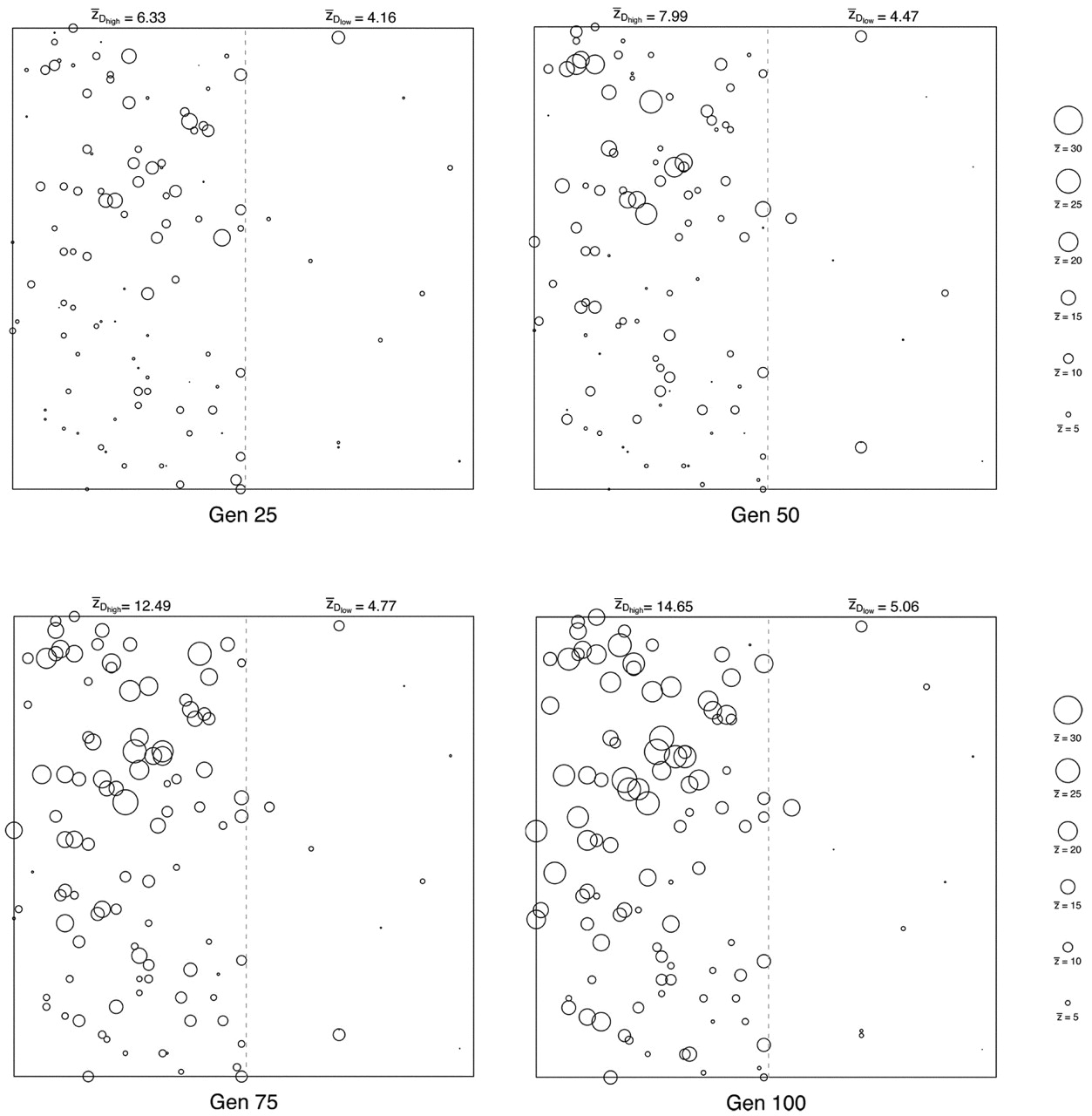
(1) To start off, {Powell et al. (2009), Science, 324, p. 1298-1301} convincingly argue that it was population density, not genetic change, that got the ball rolling on your symbolic and technological complexity in the Late Pleistocene: (z measures “level of ability at some cultural skill or in some cultural domain”.)
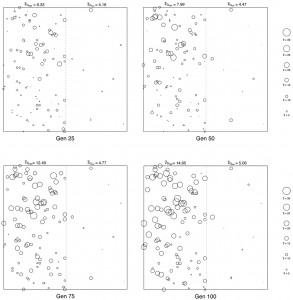 An illustration, from a single iteration and shown at 25-generation intervals, of the spatial structuring of skill accumulation in a heterogeneous subpopulation density world. The left side of each subplot is populated at density Dhigh (0.02) and the right side at density Dlow (0.002). Each subpopulation is marked by a circle, centered on the spatial location of the group and with diameter proportional to its mean z value. Regional mean z values are also given at the top of each subplot.
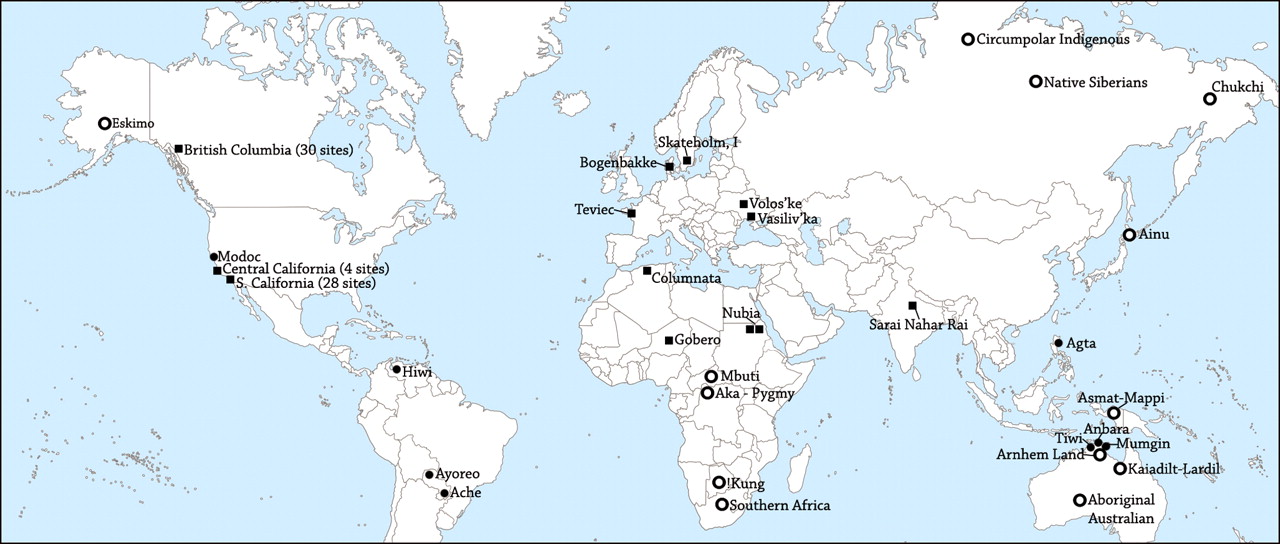
(2) And {Bowles, S. (2009), Science, 324, p. 1293-1298} argues that it was mortality due to inter-group rivalry that gave rise to your much-touted costly individual altruism. Particularly interesting is his analysis of Pleistocene mortality rates resulting from inter-group conflict:
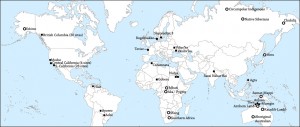 Sources of archaeological (filled squares) and ethnographic (filled dots) evidence on warfare and genetic (open dots) data on between-group differences.
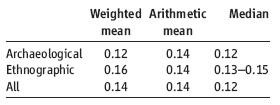 Summary statistics: Fraction of total mortality due to warfare.
 A forceful work tying economic inequality to environmental devastation.
 Smoothly written history of Western philosophy, with Jungian overtones.