 View the presentation here!
Author: Jelte
In Contradistinction

And where dost thou fit it?
Blood on the Moon

A Kalahari Family
Enheduanna’s Poetry
Thanks to my friend Melanie Lyon for introducing me to the incredible world of women’s poetry from antiquity. Enheduanna, the first known writer, was a Sumerian moon priestess who was born around 2300 B.C.E. Translations into English can be found here:
(Very) Small is Beautiful
A New Emerging View on Microbiology and its Implications for Global Ecology
Jelte P. Harnmeijer & Kenneth H. Nealson
What, you might be wondering, is an article dealing with microbes doing in The Bulletin? In an era of genetically modified agricultural products on supermarket shelves and plans – in direct contravention of international legislation – for spraying engineered fungal agents on rural communities in Colombia, readers may well be forgiven for raising their eyebrows. However, as you are about to discover, humankind – and western society in particular – has much to learn from the way microbes treat their world.
Ethan Brand
By Nathaniel Hawthorne
BARTRAM the lime-burner, a rough, heavy-looking man, begrimed with charcoal, sat watching his kiln at nightfall, while his little son played at building houses with the scattered fragments of marble, when, on the hill-side below them, they heard a roar of laughter, not mirthful, but slow, and even solemn, like a wind shaking the boughs of the forest.
The Absurd Man
By Albert Camus
“My field,” said Goethe, “is time.” That is indeed the absurd speech. What, in fact, is the Absurd Man? He who, without negating it, does nothing for the eternal. Not that nostalgia is foreign to him. But he prefers his courage and his reasoning. The first teaches him to live without appeal and to get along with what he has; the second informs him of his limits. Assured of his temporally limited freedom, of his revolt devoid of future, and of his mortal consciousness, he lives out his adventure within the span of his lifetime. That is his field, that is his action, which he shields from any judgment but his own. A greater life for him cannot mean another life. That would be unfair. I am not even speaking here of that paltry eternity that is called posterity. Mme Roland relied on herself. That rashness was taught a lesson. Posterity is glad to quote her remark, but forgets to judge it. Mme Roland is indifferent to posterity.
Rabbi Akiva on Good & Evil
 Good ol’ Rabbi Akiva ben Joseph (~50-135 CE) had it figured out. God punishes the good in this short life, for their few sins, and rewards them eternally in the world to come. Similarly, God rewards the evil-doers in this short life for their few good deeds, and punishes them eternally in the world to come. Quod erat demonstrandum.
Pierre Teilhard de Chardin
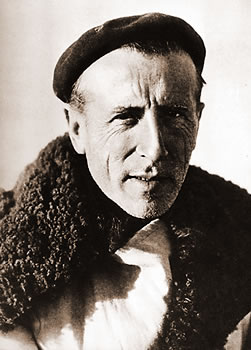 “Throughout my whole life, during every minute of it, the world has been gradually lighting up and blazing before my eyes until it has come to surround me, entirely lit up from within.”
– Pierre Teilhard de Chardin
I like this guy.