 Foucault at the top of his class.
Author: Jelte
Deversify your life
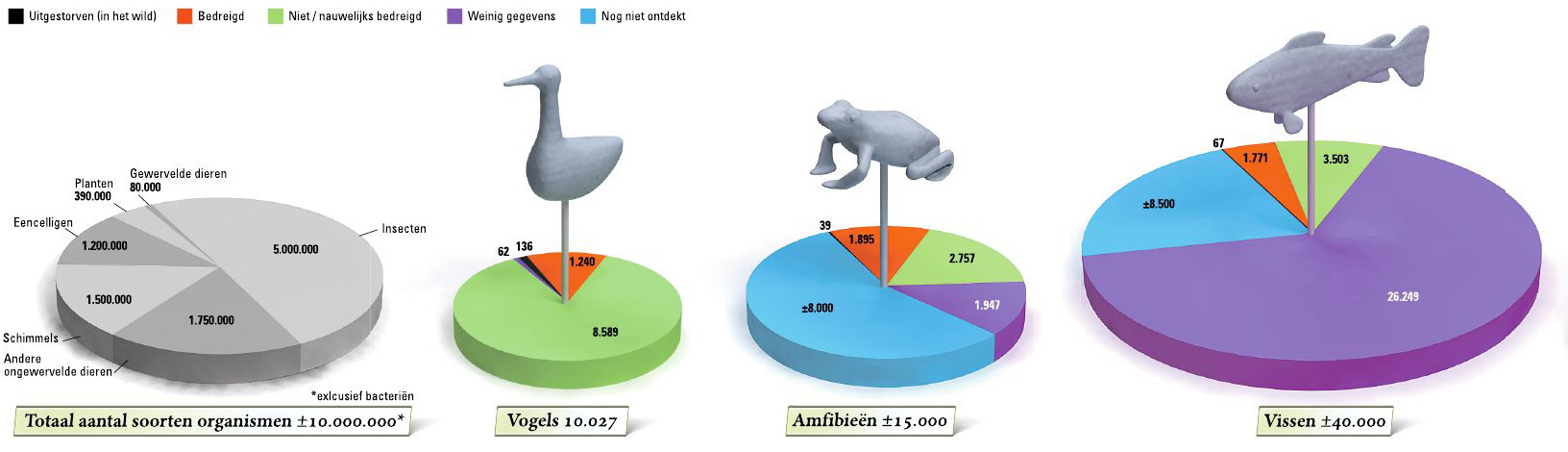
Black = extinct
Orange = threatened
Purple = no data
Blue = undiscovered
Green = doing fine
Navigare necesse est, vivere non necesse.
The Legitimization of Fortune
“The fortunate is seldom satisfied with the fact of being fortunate. Beyond this, he needs to know that he has a right to his good fortune. He wants to be convinced that he ‘deserves’ it, and above all, that he deserves it in comparison with others.”
– Max Weber, The Social Psychology of the World Religions
The Origin of Species
(1859) Charles Darwin
 Despite providing substantially more information on the inns and outs of breeding pigeons than you are liable to want, this really is quite a good read. It is surprising how little Darwin speculates on the actual mechanism of variation that leads to altered forms with novel elements.
What I thought about Sam Harris’ TED talk
I have now been asked my opinion on Sam Harris’ talk, ‘Science can answer moral questions’ (TED talk, Feb 2010), so often that I can no longer withhold it without losing serious face.
Harris’ core idea is not new, although it may be packaged to appear like it is. The basic form of his argument is that of Utilitarianism, in that ‘during moral decision making, something gets maximized’. Accordingly, many of the arguments that can be brought to bear against Utilitarianism can be leveled against Harris’ model.
But what is it that gets maximized? This is one major problem. Using the analogy of Harris’ ethical landscape, what determines the ‘evil’ depths of valleys, the ‘virtuous’ heights of mountain summits? And, more importantly, what is the decision to use a particular measure (‘happiness’/’utility’/’human wellbeing’) grounded on?
Take for instance Harris’ wild exclamation: “Why is it that we don’t have ethical obligations towards rocks?” Don’t we? You see, Harris wants to normalize his ethical landscape with humans as the measure. But how did he come to decide on this particular weighting? And how to determine how, for instance, Argentinian army ants weigh in vis-à -vis anopheles spp. mosquitoes?
Also, Harris understates the importance of knowledge. You see, for his system to find application, we first need to know what the landscape looks like. But as pointed out by G. E. Moore over a century ago, this involves very difficult, usually impossible, predictions about future consequences.
Lastly, it needs to be said that Harris’ talk was unnecessarily inflammatory, and did not paint a fair and representative picture of opposing viewpoints, not to mention Islamic culture [as if there were such a unified thing].
Foucault: A Very Short Introduction
(2005) Gary Gutting
 Super short introduction the quality of whose reflection on Foucault’s thought I’m as yet in no position to judge.
Foucault’s Project
“In what is given to us as universal, necessary, obligatory, what place is occupied by whatever is singular, contingent, and the product of arbitrary constraints?”
– Michel Foucault, The Essential Works of Michel Foucault, Volume 3: Power. Ed: James Faubion, Tr: Robert Hurley et al. (New York: New Press, 2000).
Winnett Vineyards: A Winning Combination
Winnett Vineyards: A Winning Combination, published in Two Rivers Tribune, some time in Sep 2010.
Serpentine – the snaky life-bringing mineral
Serpentine – the snaky life-bringing mineral, published in Two Rivers Tribune, some time in Sep 2010.