
Author: Jelte
A Comment on ‘Growth Fixation’
Comment on < iied.org >’s Growth Fixation posting by Tom Birch:
Just want to add two quick things here:
[1] This short-sighted preoccupation with economic growth, as part of national policy, is actually a fairly recent phenomenon. When GDP measures were initially introduced as a regular feature of national accounting (which was only in the 1940s), they were at first used towards highly specific objectives – admittedly, back then, stimulating employment was frequently one of them. And those were the dark-ages. For an example of what I mean by this, look no further than the words of U.S. Secretary of the Treasury Morgenthau at Bretton Woods (1943): “… [it is an] elementary economic axiom … that prosperity has no fixed limits. It is not a finite substance to be diminished by division.†By the 1950s, economic growth had become an end in its own right.
[2] In addition to the substance of Rachel’s linked article, Japan provides another powerful lesson for those enlightened few [yes, that’s us] that have come to see economic systems as subsystems of the geobiosphere: it is that a significant decrease in GDP energy density can be achieved while maintaining a high GDP. That is, the Japanese managed to markedly decrease their *per-dollar* carbon footprint to one of the lowest in the developed world without actually *lowering* their output. They pulled this off mostly in the decade prior to the commencement of the current recession. It may not be zero-growth, but it’s certainly a start.
Mahler’s Klavierquartettsatz in A minor
Mahler only wrote a single quartet. I think feel that’s because he, more than any other composer, tried to encapsulate everything, the World, the Universe, into each of his works – and the quartet was too restrictive in form for him. I also feel think he was the most philosophical of the master composers.
“Only add
Deeds to thy knowledge answerable; add faith;
Add virtue, patience, temperance; add love,
By name to come called Charity, the soul
Of all the rest: then wilt thou not be loth
To leave this Paradise, but shall possess
A Paradise within thee, happier far.”
– John Milton (1667), Paradise Lost.
The Working Man’s Death
“[T]he people only work because and so long as they are poor.” – Pieter de la Court, paraphrased in Max Weber (1904-1905; Eng. transl. 1930), The Protestant Ethic and the Spirit of Capitalism.
Aljazeera’s The Working Man’s Death:
http://english.aljazeera.net/programmes/general/2010/10/2010101113656323582.html
Obama and the Empire
(2010) Fidel Castro
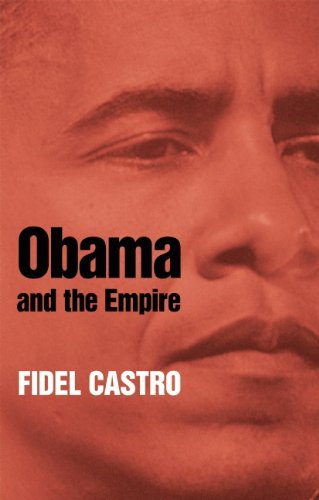 Castro has increasingly come to write with the tone of a man who addresses himself not to the present, but to the future – that is, he writes for History. This collection of short articles chronicles how Fidel’s take on President Obama shifted from early careful optimism to bitter disappointment.
Goodbye, America
Goodbye, America.
Unto This Last
(1862) John Ruskin
 “So far as I know, there is not in history record of anything so disgraceful to the human intellect as the modern idea that the commercial text, “Buy in the cheapest market and sell in the dearest,” represents, or under any circumstances could represent, an available principle of national economy. Buy in the cheapest market? yes; but what made your market cheap? Charcoal may be cheap among your roof timbers after a fire, and bricks may be cheap in your streets after an earthquake; but fire and earthquake may not therefore be national benefits. Sell in the dearest? — Yes, truly; but what made your market dear? You sold your bread well to-day: was it to a dying man who gave his last coin for it, and will never need bread more; or to a rich man who to-morrow will buy your farm over your head; or to a soldier on his way to pillage the bank in which you have put your fortune?”
Fantastic. What took me so long to discover Ruskin? Had I discovered him sooner, I would have discovered some of my own conclusions on the subject of Political Economy sooner, too.
Life is
Fog
The fog comes
on little cat feet.
It sits looking
over harbor and city
on silent haunches
and then moves on.
– Carl Sandburg